Master creative optimization with our workflow. Discover how to use data and AI to systematically test ad creatives, scale winners, and prove ROI to clients.
Juggling creative requests for a dozen clients is a major bottleneck for scaling agencies. The solution is a systematic creative optimization process, turning guesswork into a data-driven engine for growth. This guide provides a repeatable workflow for agencies to test, analyze, and improve ad creatives, ensuring you consistently scale client results and prove your value.
Creative optimization is the process of using data and AI to systematically test, analyze, and improve your ad creatives to achieve better performance and ROI. It’s not about guessing what works; it’s about building a system that tells you what works, turning creative strategy from an art into a science.
And here’s the kicker: a recent study found that AI-optimized creatives can deliver up to 2x higher CTR. ✨
This guide is built specifically for you—the agency owner, the account manager, the performance marketer who knows there’s a better way. We'll show you how to move beyond one-off tests and implement a scalable creative optimization workflow that impresses clients, frees up your team, and finally lets you focus on growth.
What You'll Learn
- How to build a repeatable creative optimization process for any client account.
- Top AI-powered creative optimization tools for agencies.
- A step-by-step workflow to test creatives and scale winners without burning up your team.
- Bonus: How to use AI to quickly diagnose creative performance and report ROI to clients.
What is Creative Optimization? (And Why It's an Agency's Secret Weapon)
Alright, let's get straight to it. Creative optimization is your agency's secret weapon for scaling. It's the shift from treating ad creative like an art project to treating it like a science experiment—one that drives significant value for your clients.
It’s about creating a system that consistently finds winning ads, so you can stop relying on luck and start delivering more consistent results. For agencies, this isn't just a "nice-to-have." It's the key to unlocking the next level of growth. Here’s why:
- Scalability: When you have a repeatable system for creative testing, you can apply it across every single client account. Onboarding a new client doesn't mean reinventing the wheel; it means plugging them into your proven process. This is how you go from managing 5 clients to 25 without your team having a collective meltdown.
- Profitability: Let’s be honest, client retention is everything. When you consistently deliver better results, clients stick around. A Zebracat study found that AI creative optimization can lead to a 72% increase in ROAS. Imagine showing that number to a client when justifying higher retainers.
- Efficiency: Think about the hours your team spends manually checking ad performance, pulling reports, and trying to figure out why a campaign suddenly tanked. A solid optimization process, powered by the right tools, automates a huge chunk of that work. This frees up your brilliant account managers to think strategically. Pro Tip: Frame creative optimization as a premium service. Instead of just being an internal process, package it as "Performance Creative Strategy" or "Data-Driven Creative Scaling." It turns your operational efficiency into a new revenue stream.
Analify AI — شاشة الـ media buyer مجاناً
بطّل تخمين أرقام الربح.
وصّل Shopify وMeta وTikTok وBosta في 5 دقايق.
ابدأ مجاناً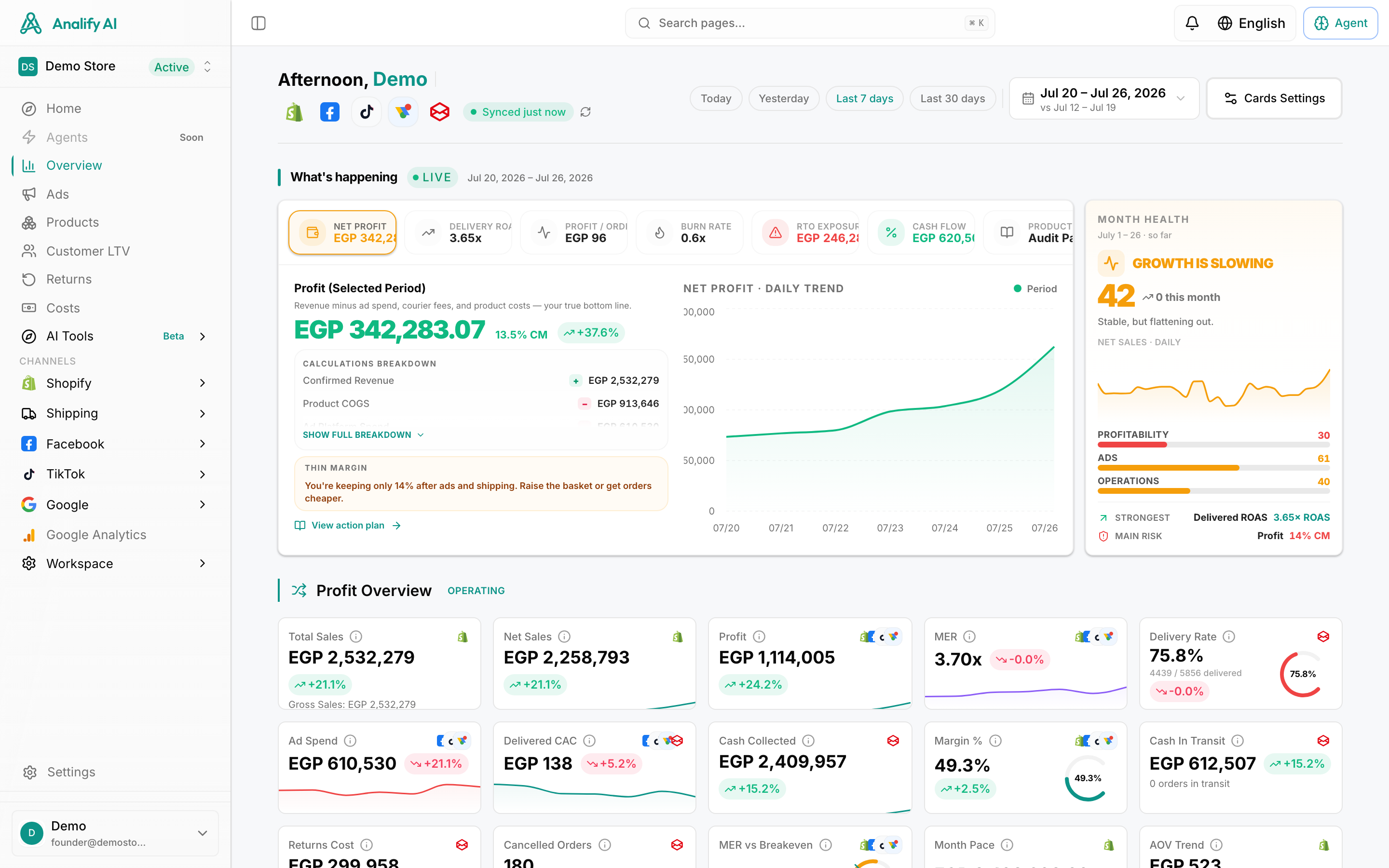
The 3 Pillars of a Winning Creative Optimization Strategy
A successful creative optimization strategy isn't just about throwing a bunch of ads at the wall to see what sticks. It's a structured process built on three core pillars. Get these right, and you'll have a powerful engine for growth.
Pillar 1: Data-Driven Hypothesis
This is where you put on your detective hat. Before you create a single new ad, you need to look at the data you already have. What worked in the past? What flopped? What are your competitors doing?
Your goal is to form a hypothesis. It sounds fancy, but it's simple: an educated guess you want to test.
- Bad Hypothesis: "Let's try some video ads."
- Good Hypothesis:"Based on our top-performing static ads featuring customer testimonials, we believe UGC-style video testimonials will outperform polished product videos for this client's cold audiences."
See the difference? The second one is specific, measurable, and based on existing data. You’re not just guessing; you’re making a strategic bet.
Pillar 2: Structured A/B Testing
Once you have your hypothesis, it's time to test it cleanly. The golden rule of A/B testing is to change only one variable at a time. If you test a new image, a new headline, and a new CTA all at once, you'll have no idea which element was responsible for the change in performance.
Here’s how to keep it clean:
- **Isolate Your Variable:**Test headlines against headlines, images against images, or audiences against audiences. Keep everything else the same.
- Use the Right Tools: Meta's Dynamic Creative feature is a great way to test different combinations of assets (images, videos, headlines, descriptions). It lets Meta's algorithm do the heavy lifting.
- Give It Enough Time & Budget: Don't call a test after 24 hours and $10 in spend. You need statistically significant data to make a smart decision.
For a deeper dive, learning how to analyze ad performance like a pro is a non-negotiable skill for any serious media buyer.
Pillar 3: Iteration and Learning
A test is useless if you don't learn from it. The final pillar is about analyzing the results and using those insights to fuel your next round of creatives. This creates a feedback loop of continuous improvement.
- Analyze Key Metrics: Look beyond just CTR. How did the creative impact Cost Per Acquisition (CPA) and Return on Ad Spend (ROAS)? A high-CTR ad that doesn't convert is a vanity metric.
- Document Everything: Create a "Creative Learnings" document for each client. Note what you tested, the results, and your key takeaways (e.g., "For Client X, lifestyle images with people consistently outperform sterile product-only shots.").
- Iterate, Don't Replicate: Use the winning elements in your next creative batch. If a certain headline style worked, try pairing it with a new image. If a UGC video was a hit, create more variations of it.
This iterative cycle is what separates amateur agencies from the pros. It ensures that every dollar spent on testing makes your future campaigns smarter.
Top Creative Optimization Tools for Agencies
The right toolstack can be the difference between a clunky, manual process and a seamless, automated workflow, and choosing the right business tools for your marketing agency is crucial. For an agency, the ideal tool acts as a central command center for creative generation, AI-powered optimization, and client reporting. Here are some leading contenders.
1. Analify (Comprehensive All-in-One Platform for Agencies)
Analify is built for agencies that need to manage multiple clients and scale efficiently. It brings together key pieces of the creative optimization puzzle into one integrated hub.