Discover how AI and machine learning in advertising technology automate campaigns, optimize targeting, and boost ROI for e-commerce businesses in 2025.
Managing 50+ product campaigns while trying to scale your Shopify store feels impossible. You're spending hours tweaking ad sets, second-guessing audience targeting, and watching your ad spend climb while conversions plateau. Sound familiar?
You're not alone – most e-commerce owners are drowning in manual campaign management while their competitors scale more efficiently. Here's the thing most e-commerce owners don't realize: successful e-commerce businesses use AI and machine learning in advertising technology to streamline optimization tasks while many businesses still rely on manual optimization.
AI and machine learning in advertising technology automate campaign management, optimize targeting through predictive analytics, personalize ad creative in real-time, and improve ROI through data-driven decision-making for e-commerce businesses. These systems learn from your customer data to make thousands of optimization decisions daily – decisions that would require significant manual analysis.
This guide breaks down exactly how AI and machine learning in advertising technology work, with specific strategies for e-commerce businesses ready to scale smarter, not harder.
What You'll Learn
- How AI automates your most time-consuming advertising tasks and saves 10+ hours weekly
- Specific machine learning applications that increase conversion rates by 14% for e-commerce
- Real implementation framework to get started without technical expertise
- Bonus: ROI calculation methods to prove your AI advertising investment pays off
Understanding AI and Machine Learning in E-commerce Advertising
Let's cut through the tech jargon. When we talk about AI and machine learning in advertising technology, we're really talking about having a tireless assistant that operates continuously with data-driven decisions and gets smarter every day.
This assistant analyzes your customer behavior, predicts which products will sell, and adjusts your campaigns accordingly. No more midnight bid adjustments or weekend campaign monitoring.
Artificial Intelligence (AI) refers to computer systems that perform tasks typically requiring human intelligence. For e-commerce, this means recognizing which customers are most likely to buy your products based on their browsing behavior, purchase history, and demographic data.
Machine Learning (ML) is a subset of AI that learns from data patterns to make predictions and decisions without being explicitly programmed for each scenario. For e-commerce, this means your advertising platform gets better at targeting high-value customers the more data it processes.
Here's where it gets exciting for e-commerce owners: while traditional advertising requires you to manually test audiences, adjust bids, and optimize creative, AI assists with these optimization tasks. According to recent stats, 88% of digital marketers now use AI daily, and the results speak for themselves.
The magic happens in three key areas for e-commerce businesses:
- Product Catalog Intelligence: AI analyzes which products perform best with specific audiences, automatically promoting high-margin items to customers most likely to purchase them. Instead of manually creating campaigns for each product, the system identifies patterns and scales winning combinations.
- Customer Journey Optimization: Machine learning tracks how customers interact with your brand across touchpoints, predicting the optimal moment to show specific ads. This means showing abandoned cart ads at precisely the right time or promoting complementary products based on purchase history.
- Seasonal Pattern Recognition: AI identifies seasonal trends in your data, automatically adjusting campaign priorities and budgets based on historical performance. No more scrambling to manually scale campaigns during Black Friday – the system anticipates and prepares.
The beauty of modern AI advertising platforms is that they're designed specifically for e-commerce challenges. Platforms like Analify integrate directly with Shopify, understanding your product catalog, inventory levels, and profit margins to make optimization decisions that actually impact your bottom line.
Pro Tip: Start thinking of AI not as a replacement for your advertising knowledge, but as an amplifier. Your understanding of your customers and products guides the AI, while the AI handles the repetitive optimization tasks that consume your time.
Analify AI — وصّل سياق البيزنس بالـ AI مجاناً
بطّل تخمين أرقام الربح.
وصّل Shopify وMeta وTikTok وBosta في 5 دقايق.
ابدأ مجاناً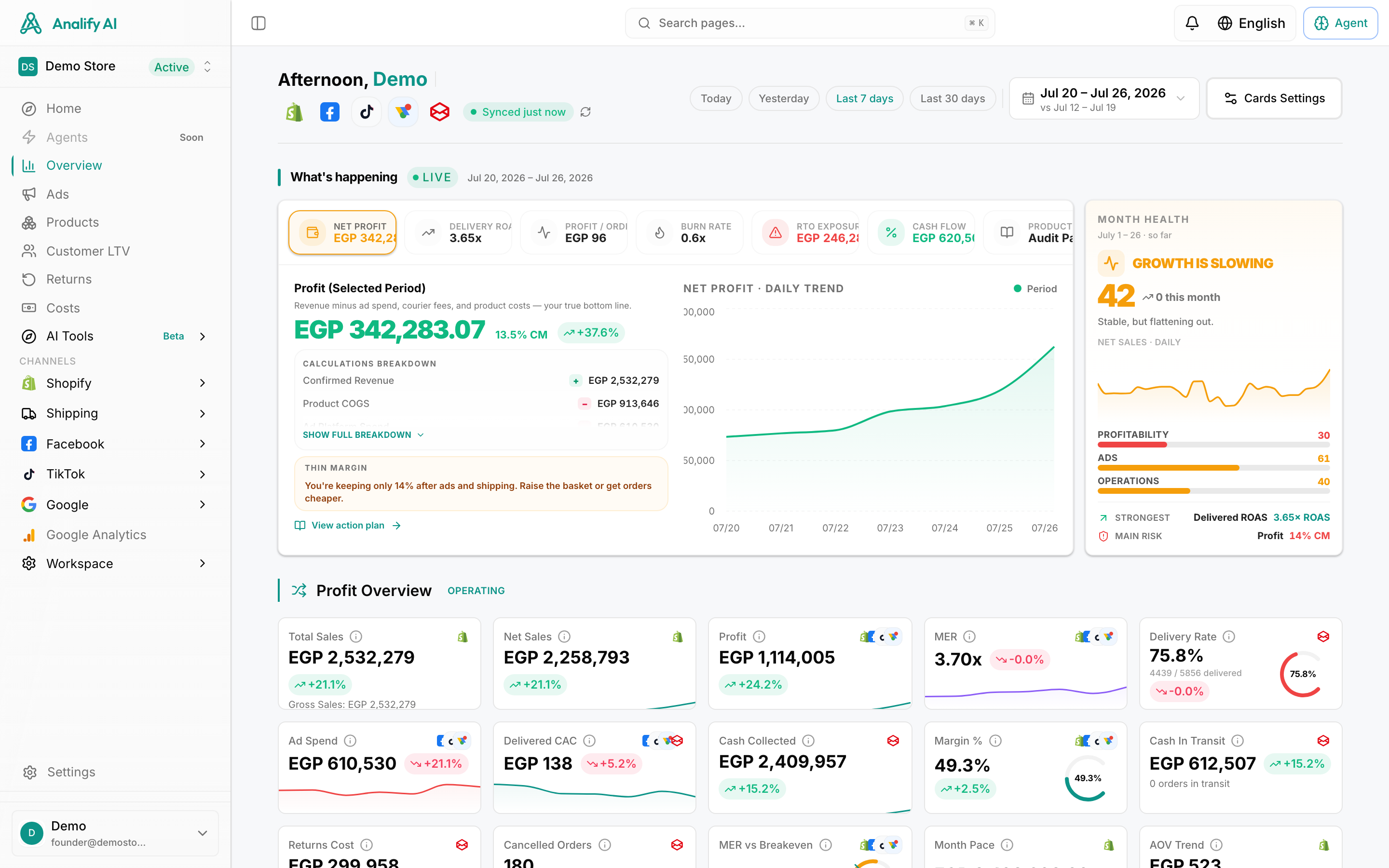
Core AI Applications That Transform E-commerce Advertising
Now let's dive into the specific ways AI and machine learning in advertising technology revolutionize e-commerce advertising. These aren't theoretical concepts – they're practical applications you can implement today to see immediate improvements in your campaign performance.
Automated Product Feed Optimization
Your product catalog is the foundation of your advertising success, but manually optimizing hundreds or thousands of products is impossible. AI changes this game completely.
- Dynamic Product Prioritization: Machine learning algorithms analyze which products generate the highest return on ad spend (ROAS) and automatically allocate more budget to these winners. Instead of spreading your budget equally across all products, AI identifies your profit drivers and scales them aggressively.
- Inventory-Based Campaign Management: AI monitors your inventory levels and automatically pauses ads for out-of-stock items while boosting promotion for overstocked products. This prevents wasted ad spend on unavailable items and helps move inventory strategically.
- Cross-sell and Upsell Automation: The system identifies purchase patterns to automatically create campaigns promoting complementary products. If customers who buy running shoes often purchase fitness trackers, AI creates targeted campaigns showing fitness trackers to running shoe buyers.
Predictive Customer Targeting
Traditional audience targeting relies on demographics and interests, but AI goes deeper by predicting customer behavior based on actual data patterns.
- Lookalike Modeling for High-Value Customers: Instead of creating lookalike audiences based on all customers, AI identifies your highest lifetime value customers and creates audiences that mirror their characteristics. This approach typically improves customer acquisition quality by 30-40%.
- Purchase Intent Prediction: Machine learning algorithms analyze browsing behavior, time spent on product pages, and interaction patterns to predict when someone is ready to buy. This allows you to show ads at the optimal moment in the customer journey.
- Abandoned Cart Recovery Optimization: AI determines the best timing, messaging, and incentives for abandoned cart campaigns based on individual customer behavior. Some customers respond to immediate follow-up, others need a few days and a discount code.
Dynamic Creative Optimization for Products
Creating and testing ad creative for multiple products manually is time-intensive and often inconsistent. AI streamlines this process while improving performance.
- Automatic A/B Testing of Product Images: AI tests different product images, angles, and backgrounds to determine which creative elements drive the highest conversion rates for each product category. The system automatically promotes winning creative combinations.
- Personalized Ad Copy Generation: Machine learning analyzes which messaging resonates with different customer segments and automatically generates ad copy variations. For example, price-sensitive customers might see discount-focused copy, while quality-focused customers see feature-benefit messaging.
- Seasonal Creative Adaptation: AI recognizes seasonal patterns and automatically adjusts creative elements. Summer campaigns for outdoor products get bright, energetic creative, while winter campaigns emphasize warmth and comfort.
Real-Time Campaign Management
The most powerful application of AI and machine learning in advertising technology is real-time optimization that happens 24/7 without your intervention.
- Automated Bid Adjustments: AI continuously monitors campaign performance and adjusts bids based on your target ROAS or cost per acquisition (CPA). When a campaign starts performing well, bids increase to capture more volume. When performance drops, bids decrease to maintain profitability.
- Budget Reallocation Between Products: Instead of setting fixed budgets for each product campaign, AI dynamically shifts budget from underperforming products to winners throughout the day. This ensures your ad spend always goes to the highest-performing opportunities.
- Performance-Based Scaling Decisions: Machine learning identifies when campaigns are ready to scale by analyzing performance stability, audience saturation, and profit margins. The system automatically increases budgets for campaigns showing consistent profitability while maintaining efficiency.
Platforms like Analify excel in this area because they're built specifically for e-commerce businesses. The AI Marketer tool performs daily Meta account audits and provides one-click optimization recommendations, essentially giving you an expert campaign manager working around the clock.