Master AI-driven advertising for mobile commerce with our guide. Learn proven strategies and implementation steps to boost conversions and ROAS.
Picture this: You're watching your mobile commerce sales plateau while your ad costs keep climbing. Sound familiar?
You're not alone. With mobile commerce hitting $4 trillion by 2025, the competition for mobile shoppers has never been fiercer.
Here's the thing – traditional advertising approaches simply can't keep up with the lightning-fast pace of mobile user behavior. While you're manually adjusting campaigns and guessing at what creative will work, your competitors are using AI to optimize in real-time, personalize at scale, and capture mobile sales you're missing.
But here's the good news: AI-driven advertising for mobile commerce isn't just for tech giants anymore. E-commerce businesses of all sizes are using artificial intelligence to transform their mobile commerce performance, and the results are impressive. We're talking about potential for significant conversion rate improvements, ROAS optimization, and dramatically reducing campaign management time.
In this guide, we'll walk you through exactly how to implement AI-driven advertising for mobile commerce. No fluff, no theory – just actionable steps, real performance data, and proven strategies that are working right now.
What You'll Learn
Ready to dive in? Here's exactly what we'll cover:
- How AI can significantly improve mobile commerce conversion rates through hyper-personalized targeting that actually understands your customers
- 6 proven AI applications that can dramatically reduce your campaign management time while improving performance
- Step-by-step implementation roadmap with budget guidelines and realistic timeline expectations
- Bonus: Real case studies showing substantial ROAS improvements with specific metrics you can benchmark against
What Is AI-Driven Advertising for Mobile Commerce?
AI-driven advertising for mobile commerce uses machine learning, predictive analytics, and automation to optimize ad targeting, creative performance, and budget allocation in real-time for mobile shoppers. It enables hyper-personalized experiences, dynamic creative optimization, and automated campaign management, with potential for significant conversion rate improvements for mobile apps and improved ROAS compared to manual optimization.
Think of it as having a team of data scientists working 24/7 to optimize your campaigns, except they never sleep, never miss a trend, and can process millions of data points in seconds. The technology combines several key components:
Machine Learning (ML) analyzes your customer behavior patterns to predict who's most likely to purchase, when they'll buy, and what creative will resonate with them. Natural Language Processing (NLP) helps understand customer intent from search queries and social interactions. Predictive Analytics forecasts campaign performance and identifies scaling opportunities before you even see them in your dashboard.
This isn't just a fancy upgrade to traditional mobile advertising – it's a completely different approach. While traditional methods rely on broad demographic targeting and manual optimization, AI-driven advertising for mobile commerce creates individual customer profiles and optimizes for each person's unique journey.
Why does this matter for mobile commerce specifically? By 2028, mobile will account for 70% of digital ad spend, but mobile users behave differently than desktop users. They're more impulsive, have shorter attention spans, and expect instant gratification. AI helps you capitalize on these behaviors by delivering the right message at the exact moment they're ready to buy.
Analify AI — شاشة الـ media buyer مجاناً
بطّل تخمين أرقام الربح.
وصّل Shopify وMeta وTikTok وBosta في 5 دقايق.
ابدأ مجاناً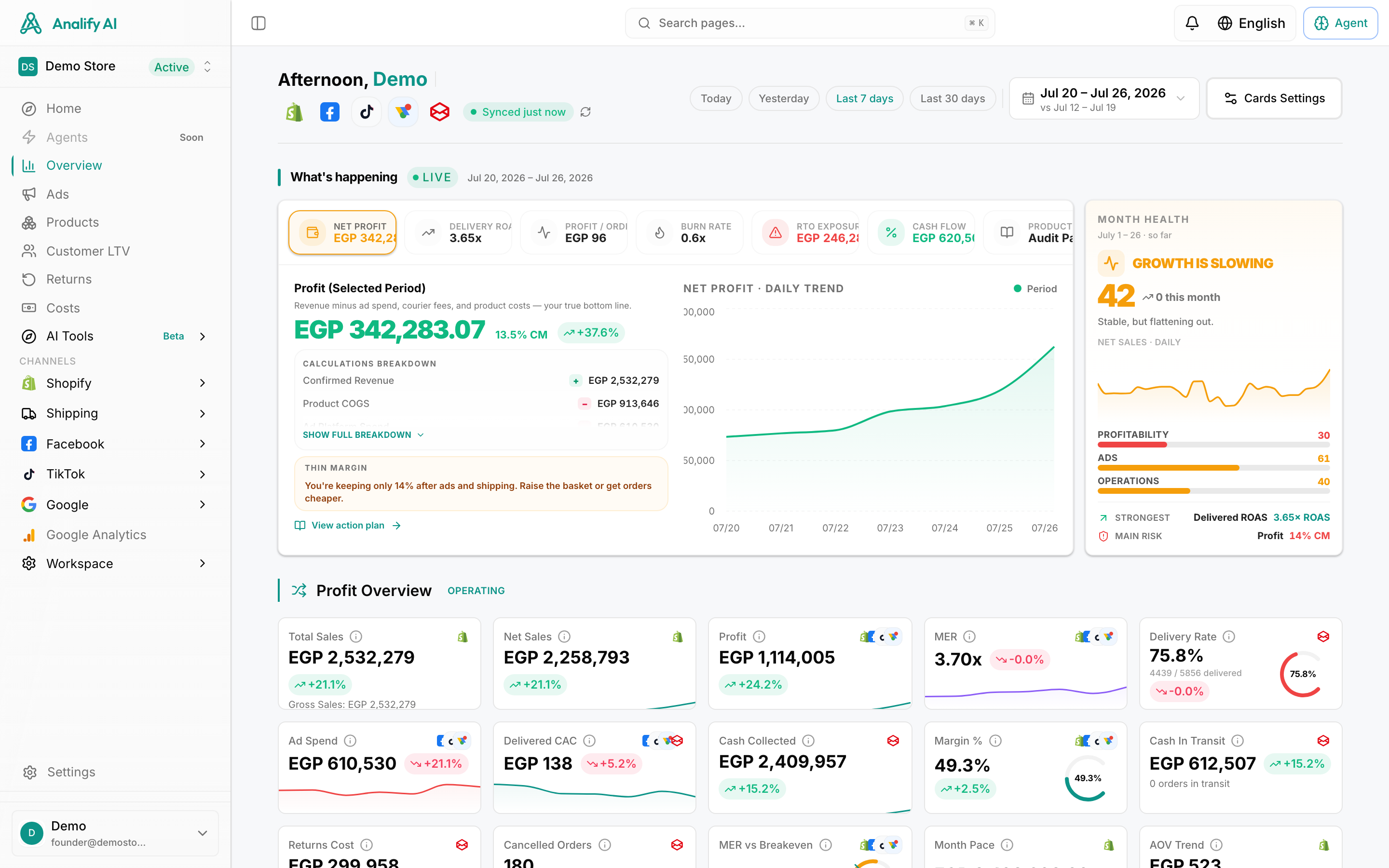
The 6 Core AI Applications Transforming Mobile Commerce
Let's break down the specific AI applications that are driving real results for e-commerce businesses. Each of these works differently, but when combined, they create a powerful system that often outperforms manual optimization.
1. Hyper-Personalized Ad Targeting
What it is: AI analyzes multiple data points to identify your ideal mobile customers, going far beyond basic demographics to understand purchase intent, browsing patterns, and behavioral triggers.
How it works: The system processes real-time behavior data, purchase history, app interactions, and even external signals like weather or local events to create dynamic customer profiles. Instead of targeting "women aged 25-35," you're targeting "women who browse fashion apps on weekends, have purchased similar items in the past 30 days, and typically convert within 2 hours of first seeing an ad."
For example, Analify AI Audiences automatically creates high-performing lookalike audiences by identifying the subtle patterns that connect your best customers – patterns humans would never spot manually.
Results: This level of precision targeting can deliver significantly higher conversion rates for mobile apps compared to mobile web, because you're reaching people when they're most likely to take action.
Pro tip: Start with your purchase behavior data – it's the strongest signal for AI to learn from and typically delivers the fastest results.
2. Dynamic Creative Optimization (DCO)
What it is: AI automatically tests and combines different ad elements (headlines, images, CTAs, descriptions) in real-time, helping create multiple creative variations with reduced manual work.
How it works: Computer vision analyzes which creative elements perform best for different audience segments, then automatically serves optimized combinations to each user. The AI might discover that blue backgrounds work better for returning customers while red backgrounds convert new customers, then serve accordingly.
Analify Creative Insights uses AI to identify top-performing Meta ad elements across your campaigns and accounts, showing you exactly which colors, text styles, and image types drive the best results for your specific audience.
Results: Businesses typically see potential for CTR improvements and ROAS optimization because each person sees creative optimized for their preferences.
Pro tip: Test 5+ creative variations simultaneously for optimal results – AI needs options to find the winning combinations.
3. Predictive Analytics & Performance Forecasting
What it is: AI predicts future campaign performance and customer lifetime value by analyzing historical data patterns and external market signals.
How it works: Machine learning models process your historical campaign data, seasonal trends, competitor activity, and market conditions to forecast performance. The system can predict which customers are likely to churn, which campaigns will scale successfully, and how much budget you'll need to hit specific revenue targets.
Applications: The most valuable applications include:
- Churn prediction (identifying customers likely to stop purchasing)
- Budget forecasting (predicting optimal spend levels)
- Audience expansion (finding new customer segments similar to your best performers)
Results: Businesses using predictive analytics can see potential for reduced customer acquisition costs because they're focusing spend on the highest-value opportunities.
Implementation note: You'll need at least 30 days of baseline data for accurate predictions – the more data, the better the forecasts.
4. Real-Time Bid & Budget Optimization
What it is: AI adjusts your ad spending automatically based on real-time performance data, moving budget away from underperforming campaigns and scaling winners with minimal manual intervention.
How it works: The system continuously monitors campaign performance against your goals (ROAS, CPA, conversion volume) and makes micro-adjustments throughout the day. If a campaign starts performing well at 2 PM, AI immediately increases its budget. If performance drops, it reduces spend before you waste money.
Analify Autonomous Budget Optimizer, for instance, redistributes Meta ad spend across campaigns automatically, ensuring your budget always flows to the highest-performing opportunities.
Results: This provides continuous optimization with minimal manual oversight – your campaigns improve while you sleep, and you never miss a scaling opportunity or waste budget on poor performance.