Master analytics for marketing to scale your agency. Learn to build a scalable framework, track key client metrics, and use the right tools to prove ROI.
Picture this: It's 9 AM on a Monday. You, a star account manager, are staring at a screen that looks like a scene from The Matrix.
You've got 15 tabs open—one for each client's Facebook Ads Manager, another for their Google Ads, a few for TikTok, and a smattering of Shopify dashboards. Your mission? Wrangle this digital beast into a coherent, insightful report for each client. By the time you're done, it's Tuesday.
You're not alone in this data jungle. The core problem for every growing agency is that data is everywhere, but real, actionable insights are infuriatingly scarce. And your most valuable, non-renewable asset? Time. It's being devoured by spreadsheets. In fact, a staggering 43% of marketers cite data silos as their top frustration, and for agencies, that frustration is multiplied by every client you onboard.
Let's cut through the noise. Effective analytics for marketing is the process of measuring, managing, and analyzing marketing performance to maximize its effectiveness and optimize return on investment (ROI). For agencies, it's the engine that proves your value, keeps clients happy, and lets you scale without burning out. This isn't just another buzzword; it's your blueprint for turning data chaos into a streamlined system that makes you look like a hero to clients and management.
What You'll Learn
- How to build a scalable analytics framework for your entire client portfolio.
- The key difference between web and marketing analytics (and how to explain it to clients).
- Which KPIs actually prove your agency's value and justify your fees.
- A step-by-step process for implementing an analytics system across your agency.
- Bonus: A downloadable tool selection checklist for agencies.
What Are Analytics for Marketing? (An Agency Superpower)
We've given you the textbook definition, but let's be real. For an agency, analytics for marketing is so much more than just "analyzing performance." It's your secret weapon.
It's the difference between being a disposable "service provider" and an invaluable "strategic partner."
When you master marketing analytics, you are:
- **Proving Your Worth:**You're connecting ad spend directly to your client's revenue, leaving no doubt about the value you provide.
- **Boosting Client Retention:**Transparent, insightful data builds trust. And trusted partners stick around for the long haul. This is crucial for improving client retention and stabilizing your agency's revenue.
- **Unlocking Upsell Opportunities:**When you can show a client that Channel A is crushing it, it's an easy conversation to suggest increasing the budget or expanding services.
- **Scaling Your Agency Efficiently:**A standardized analytics process means you can onboard more clients without proportionally increasing your headcount. It's the key to profitable growth.
Don't just take our word for it. A 2024 study by Forrester found that firms that effectively operationalize their customer data significantly outpace their peers in both revenue and profit growth. For your agency, that means turning client data into your most powerful growth asset.
Analify AI — شاشة الـ media buyer مجاناً
بطّل تخمين أرقام الربح.
وصّل Shopify وMeta وTikTok وBosta في 5 دقايق.
ابدأ مجاناً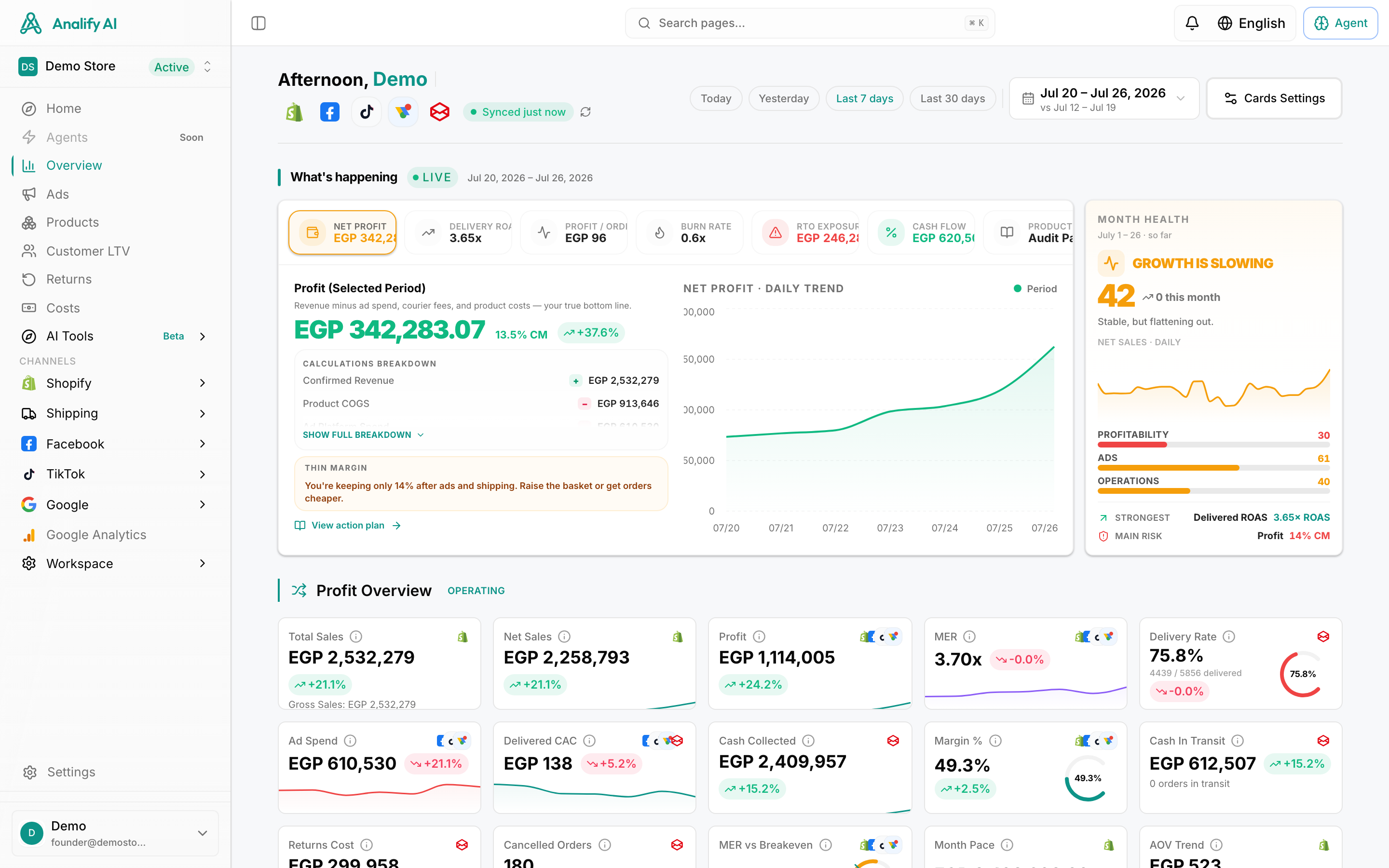
Marketing Analytics vs. Web Analytics: The Crucial Difference
Here's a conversation every agency has had: a client forwards you their Google Analytics report and asks, "Why doesn't the revenue here match the revenue in your Facebook Ads report?"
Sigh. We've all been there.
Educating your clients on this difference is a game-changer. It helps manage expectations, defines the scope of your work, and positions you as the expert they hired you to be.
Here's a simple analogy: Web analytics tells you what happened inside your client's house (the website). Marketing analytics tells you how people found the house, why they came in, and what billboard or TV ad made them decide to visit.
Here's a quick breakdown to share with your team and your clients:
Feature Marketing Analytics Web Analytics
Primary Goal
Measure the impact of marketing campaigns on business goals (ROI, CAC, Revenue).
Measure user behavior on a website (Page Views, Bounce Rate, Time on Site).
Focus
The entire customer journey, from first ad impression to final purchase.
The user's session on the website itself.
Key Questions
Which channel drove the most profitable customers? What is our total return on ad spend (ROAS)?
Which page has the highest exit rate? How long do users stay on the blog?
Primary Tools
Analify , Cross-channel reporting dashboards.
Google Analytics (GA4), Adobe Analytics.
Agency Value
Proves the financial impact of your advertising efforts.
Optimizes the on-site experience (often a separate service).
Mastering this distinction helps you control the narrative and focus client conversations on the metrics that truly demonstrate your agency's impact.
The 4 Levels of Analytics: From Reporting to Predicting Success
Think of analytics as a ladder. Most agencies are stuck on the first rung, but the real value—and the highest retainers—are at the top. Let's climb this thing together.
- Descriptive Analytics: "What Happened?" This is the foundation—the "what" of your data. It's the standard monthly performance report showing spend, clicks, and conversions. It's essential, but it's purely historical.
- Diagnostic Analytics: "Why Did It Happen?" This is where you start digging. You're not just reporting numbers; you're investigating them. For example, a client's ROAS tanks. Instead of just reporting the drop, you use a tool like Analify AI Chat to ask, "Why did ROAS drop last week?" The AI quickly analyzes the data and points to a likely cause, like ad fatigue. Now you have an answer, not just a problem.
- Predictive Analytics: "What Is Likely to Happen?" Now we're getting fancy. This involves using historical data to forecast future outcomes. For example, using a client's past Q4 data, you forecast a 25% revenue increase if they boost ad spend by 15% in November. This moves you from reactive to proactive.
- Prescriptive Analytics: "What Should We Do About It?" This is the top of the ladder, where you become a true strategist. It recommends specific actions to achieve a better outcome. For example, your platform suggests shifting 20% of a client's budget from Google Search to TikTok to improve their overall blended ROAS. You're now providing data-driven strategic guidance.
Your goal as an agency is to move every client up this ladder, from simple reporting to prescriptive, strategic guidance. That's where the real magic happens.
The Agency Analytics Workflow: A 4-Step Process for Repeatable Results
Okay, theory is great. But how do you actually do this across 10, 20, or 100 client accounts without losing your mind? You need a system.
Here's our 4-step process designed for agency operations:
Step 1: Centralize Data Collection
Stop the tab-switching madness. The first step is to pull all your client data from every platform—Meta, Google, TikTok, Shopify, GA4, Klaviyo—into one central hub.
Step 2: Analyze for Insights
With all your data in one place, you can finally see the big picture. Look for trends and patterns not just within one account, but across your entire client portfolio.
Step 3: Streamline Client Reporting
Create standardized report templates that can be deployed across multiple clients with a few clicks. A great report should be visual, easy to understand, and focused on business KPIs, not vanity metrics.
Step 4: Act with Confidence
Turn insights into action. Use your analysis to make data-backed optimization decisions. When you can say, "We need to pause this ad set because our data shows it's driving up your CAC," you're operating from a position of power. This is critical, especially when poor data quality can lead to 21% of media budgets being wasted.
Here's what that looks like visually:
[Data Sources: Meta, Google, TikTok] → [Step 1: Centralize in Analify] → [Step 2: Analyze with Dashboards & AI] → [Step 3: Report with One-Click Templates] → [Step 4: Act & Optimize]
This workflow transforms analytics from a chaotic task into a streamlined, value-driving engine for your agency.
Analify AI — شاشة الـ media buyer مجاناً
بطّل تخمين أرقام الربح.
وصّل Shopify وMeta وTikTok وBosta في 5 دقايق.
ابدأ مجاناًThe Modern Marketing Analytics Toolkit for Agencies
Alright, let's talk gear. Choosing the right tools is critical. A great tool empowers your team, saves hundreds of hours, and makes you look like a genius to your clients.
Choosing the Right Tools for Multi-Client Reporting
For agencies, the single most important feature is the ability to manage multiple clients and ad platforms without friction. This is where an all-in-one platform like Analify is built for this exact purpose. It's designed to solve agency pain points by combining: