Discover how AI ad optimization suggestions work. Learn the machine learning algorithms, data requirements, and logic behind automated recommendations.
Picture this: You're reviewing your campaign performance at 2 AM (we've all been there), and you notice something fascinating. Yesterday, your AI optimization tool suggested increasing your lookalike audience from 1% to 3% for a specific ad set.
You were skeptical – conventional wisdom says tighter audiences perform better, right? But you trusted the algorithm, made the change, and watched your CTR jump 40% overnight.
Now you're staring at those green numbers wondering: How did the AI know that would work?
Here's the thing most performance marketers don't realize: AI ad optimization suggestions aren't magic black boxes making random recommendations. They're powered by sophisticated machine learning algorithms – primarily Random Forest and Gradient Boosting models – that analyze thousands of data points in real-time to predict campaign performance and recommend specific optimizations with mathematical precision.
Understanding the actual logic behind these AI ad optimization suggestions logic isn't just satisfying your curiosity (though that's valid too). It's about gaining a competitive advantage. When you know why the AI suggests what it suggests, you can make smarter decisions about when to trust it, when to override it, and how to set up your campaigns for maximum AI effectiveness.
What You'll Learn About AI Ad Optimization Suggestions Logic
By the end of this guide, you'll understand:
- The specific machine learning models powering AI optimization suggestions (Random Forest, neural networks, gradient boosting)
- How real-time data processing creates millisecond-level optimization decisions
- The training data requirements and quality factors that determine suggestion accuracy
- Step-by-step breakdown of how AI evaluates and ranks optimization opportunities
- Bonus: How to validate AI suggestions and maintain strategic control over your campaigns
The Machine Learning Foundation: Understanding AI Suggestion Algorithms
Let's start with the technical foundation. Modern AI optimization systems rely on three primary machine learning approaches, each serving a specific purpose in the suggestion generation process.
Random Forest Models: The Accuracy Powerhouse
Random Forest algorithms achieve 95% accuracy in performance prediction by combining hundreds of decision trees, each trained on different subsets of your campaign data. Here's why this matters for your campaigns:
Each "tree" in the forest makes predictions based on different combinations of variables – audience demographics, ad creative elements, bidding strategies, time of day, device types, and dozens of other factors. The final suggestion represents the consensus of all these trees, which is why Random Forest models are so reliable for ad optimization.
Pro Tip: Random Forest models excel at ad optimization because they're inherently interpretable. Unlike neural networks that operate as black boxes, you can actually trace back why a specific suggestion was made by examining which variables carried the most weight in the decision trees.
Gradient Boosting Systems: Sequential Learning for Performance Prediction
While Random Forest models work in parallel, Gradient Boosting takes a sequential approach. Each model in the sequence learns from the mistakes of the previous one, gradually improving prediction accuracy.
This is particularly powerful for audience targeting AI because it can identify subtle patterns that single models might miss.
For example, if the first model incorrectly predicts that 25-34 year-olds will have the highest conversion rate for your product, the next model specifically focuses on correcting that error by analyzing additional variables like interests, behaviors, and purchase history.
Neural Network Applications: Deep Learning for Pattern Recognition
Neural networks handle the most complex pattern recognition tasks in AI optimization. They're particularly effective at analyzing creative elements – identifying which combinations of headlines, images, and call-to-action buttons perform best for specific audience segments.
The key advantage? Neural networks can identify non-linear relationships that traditional statistical models miss. They might discover that blue-colored ads perform 30% better for lookalike audiences but 15% worse for interest-based targeting – insights that would be nearly impossible to uncover manually.
Analify AI — شاشة الـ media buyer مجاناً
بطّل تخمين أرقام الربح.
وصّل Shopify وMeta وTikTok وBosta في 5 دقايق.
ابدأ مجاناً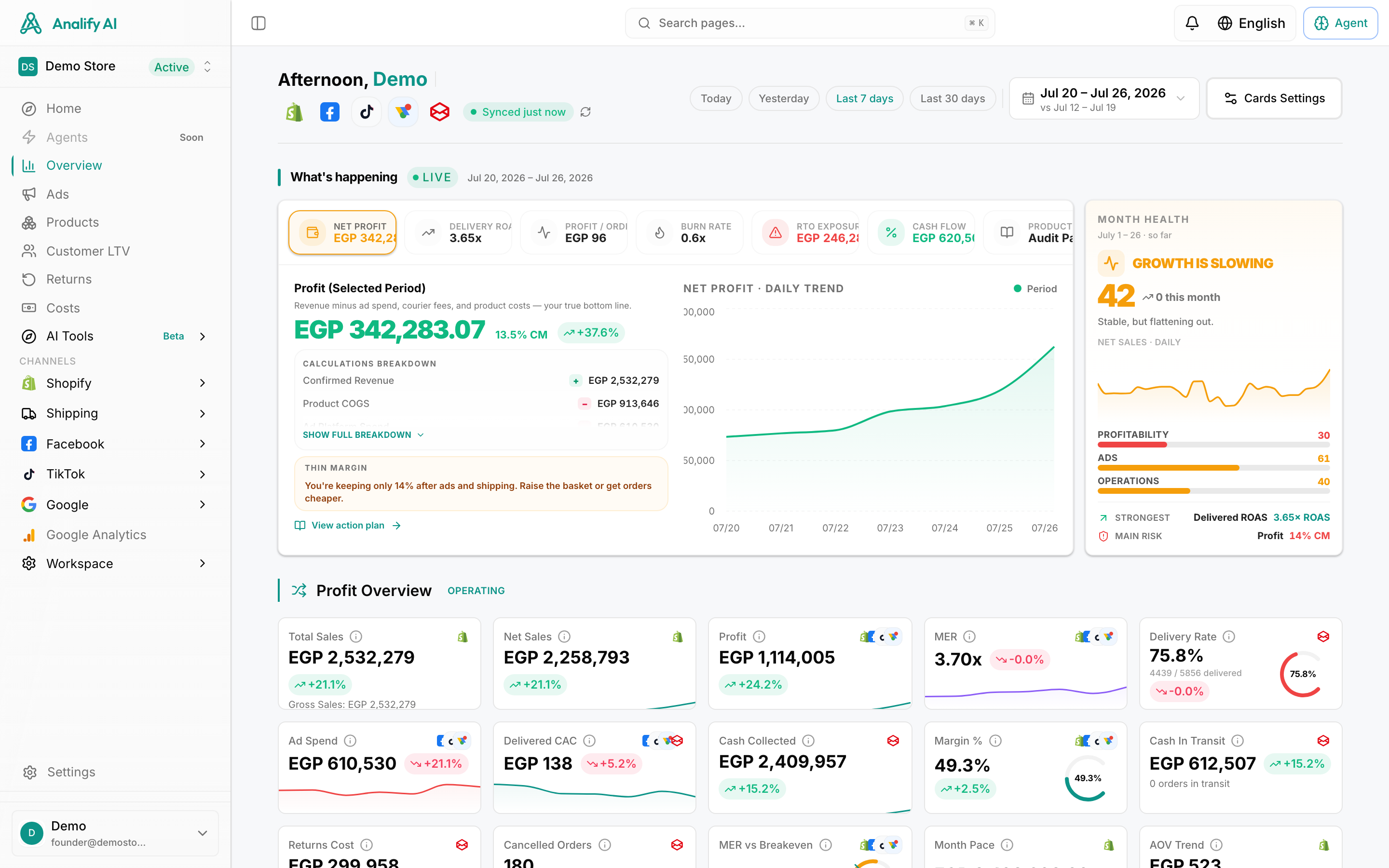
Real-Time Data Processing: The Millisecond Decision Engine
Here's where things get really interesting. Modern AI optimization doesn't just analyze your data once per day – it's processing information in real-time, making optimization decisions in milliseconds.
Data Ingestion Pipeline: Processing Thousands of Signals Simultaneously
Every time someone interacts with your ad, the AI system ingests dozens of data points:
- User demographics and behavior patterns
- Device and platform information
- Time and location data
- Previous interaction history
- Current campaign performance metrics
- Competitive landscape changes
- Market trend indicators
This data flows through what's called a "feature engineering" pipeline, where raw information gets transformed into optimization insights. For instance, "user clicked ad at 3:47 PM on mobile device" becomes part of a broader pattern analysis about optimal timing and device targeting.
Scoring Algorithms: How Suggestions Are Ranked and Prioritized
Not all optimization opportunities are created equal. AI systems use sophisticated scoring algorithms to rank suggestions based on:
- Expected Impact: Predicted performance improvement percentage
- Confidence Level: How certain the AI is about the prediction
- Implementation Risk: Potential downside if the suggestion doesn't work
- Resource Requirements: Budget or time needed to implement
- Strategic Alignment: How well the suggestion fits your campaign objectives
Analify builds on these machine learning foundations and acts as your AI Marketer, turning complex algorithms into actionable growth strategies. It continuously analyzes real-time campaign signals across platforms. The platform doesn’t just surface insights—it provides ranked, confidence-scored recommendations you can act on instantly. From automated bid adjustments and audience discovery to creative testing and budget allocation, Analify transforms the science of AI optimization into a practical control tower for your e-commerce advertising, helping you scale with less guesswork and more precision.