Discover how AI-driven advertising automation saves e-commerce businesses 30+ hours monthly. Reduce reporting time with automated insights.
If you're spending your Sunday evenings pulling Facebook ad data into spreadsheets instead of planning your next product launch, you're not alone. We've talked to hundreds of e-commerce owners who tell us the same story: "I started this business to sell products, not to become a data analyst."
Here's the thing – you're probably spending way more time on ad reporting than you realize. The average e-commerce business owner dedicates 20% of their workweek to reporting tasks, which translates to roughly 8 hours weekly just pulling numbers from different platforms. That's time you could be spending on product development, customer service, or actually growing your business.
AI-driven advertising for automated reporting uses machine learning to automatically collect, analyze, and visualize campaign data from multiple platforms, designed to reduce reporting time by up to 80% while delivering real-time insights through customizable dashboards. Instead of manually logging into Facebook Ads Manager, Google Ads, and your analytics platform every morning, AI automation pulls all your data into one place, identifies trends, and even suggests optimizations.
The best part? You don't need a computer science degree to set this up. Modern AI automation platforms are designed for business owners like you – people who want results without the technical headaches.
What You'll Learn
By the end of this guide, you'll know exactly how to:
- Reduce your ad reporting time from 6 hours to 30 minutes weekly
- Choose the right AI automation tools that deliver measurable ROI for e-commerce businesses
- Set up your automation system step-by-step (designed to pay for itself in the first month)
- Calculate your exact savings potential with our free ROI calculation guide
What Is AI-Driven Advertising for Automated Reporting?
Let's start with the basics. AI-driven advertising for automated reporting is a system that uses artificial intelligence to handle the repetitive, time-consuming tasks that eat up your day. Think of it as having a really smart assistant who never sleeps, never makes calculation errors, and can process thousands of data points in seconds.
Here's how it works in practice:
Data Collection: The AI automatically connects to all your advertising platforms (Facebook, Google, TikTok, etc.) and pulls performance data in real-time. No more logging into five different dashboards every morning.
Analysis: Machine learning algorithms analyze your data to identify patterns, trends, and anomalies. It's like having a data scientist who can spot when your cost per acquisition is trending upward before it becomes a problem.
Insights Generation: The AI translates complex data into actionable insights. Instead of staring at a spreadsheet wondering why your ROAS dropped, you get clear explanations like "Your audience is showing fatigue – consider refreshing your creative."
Automated Recommendations: Advanced systems can provide optimization recommendations based on predefined rules. If your cost per acquisition exceeds your target by 20%, the system can suggest pausing underperforming ad sets and reallocating budget to winners.
The Key Components That Make This Possible
Platform Integrations: Direct API connections to advertising platforms, analytics tools, and e-commerce systems like Shopify. This ensures data flows seamlessly without manual intervention.
Customizable Dashboards: Visual interfaces that present your most important metrics in an easy-to-understand format. No more squinting at tiny numbers in Facebook Ads Manager.
AI-Powered Insights: Machine learning models trained on millions of advertising campaigns that can identify optimization opportunities you might miss.
Automated Reporting: Scheduled reports that get delivered to your inbox or shared with your team automatically. Your Monday morning performance review becomes a 5-minute email scan instead of a 2-hour data-pulling session.
Pro Tip: Who benefits most from this technology? E-commerce businesses scaling their ad spend are the sweet spot. If you're spending $5,000+ monthly on advertising and currently managing campaigns manually, automation can deliver immediate ROI.
Analify AI — شاشة الـ media buyer مجاناً
بطّل تخمين أرقام الربح.
وصّل Shopify وMeta وTikTok وBosta في 5 دقايق.
ابدأ مجاناً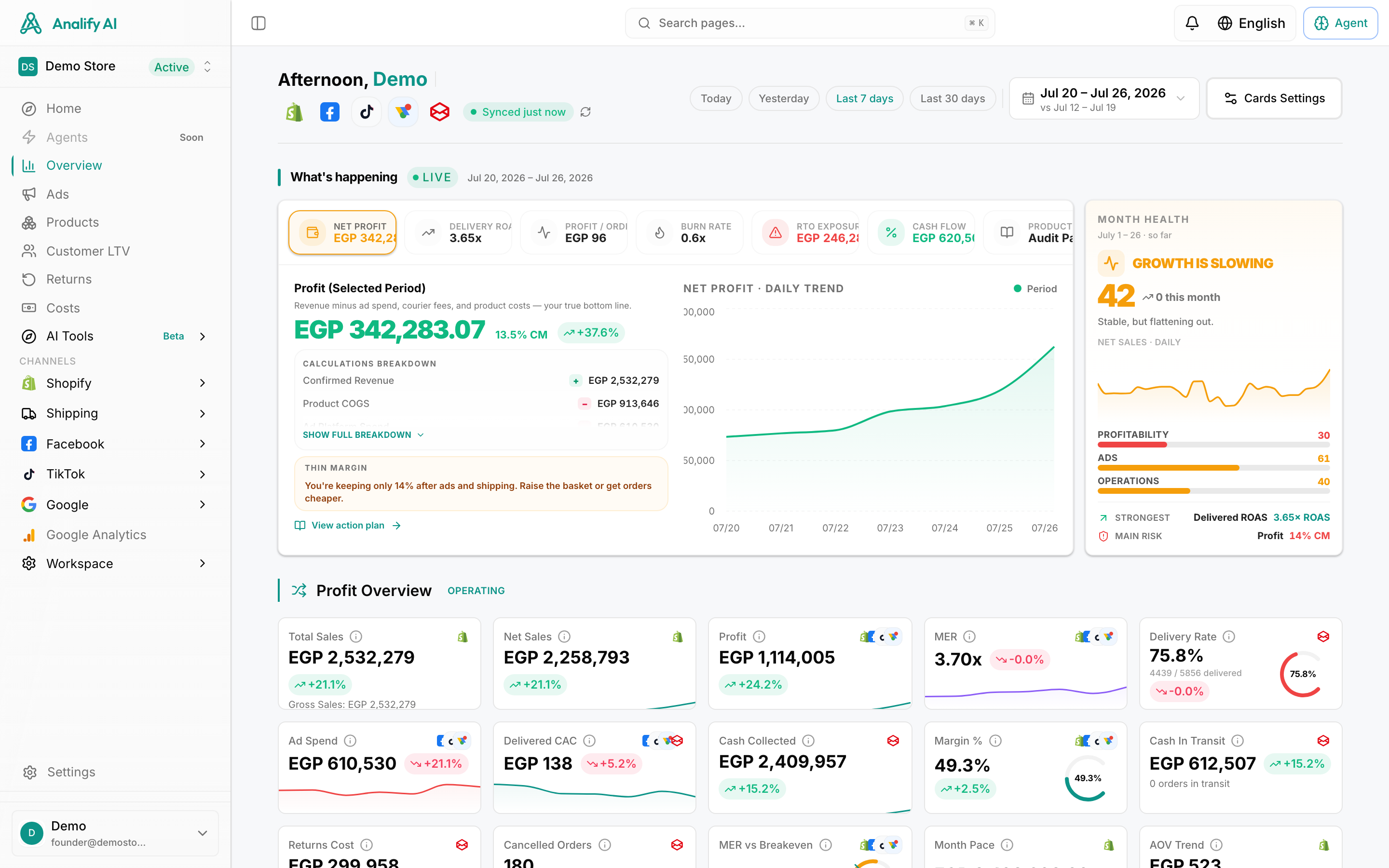
Why E-commerce Needs Automated Reporting Now
The advertising landscape has become incredibly complex, and manual management simply doesn't scale anymore. Here's why smart e-commerce businesses are making the switch to AI-driven advertising for automated reporting:
The Market Reality Check
The Market Is Exploding: The AI marketing automation market is projected to reach $47.32 billion by 2025, driven primarily by businesses realizing they can't compete manually anymore. Your competitors are already automating – the question is whether you'll join them or get left behind.
Time Is Your Most Valuable Resource: Research shows that business owners spend 20% of their workweek on reporting and data analysis tasks. For a typical 50-hour work week, that's 10 hours spent pulling numbers instead of growing your business. If you value your time at $50/hour (conservative for most e-commerce owners), you're losing $26,000 annually to manual reporting.
The Hidden Costs of Manual Management
Manual Errors Are Expensive: Poor data quality costs businesses an average of $12.9 million annually, according to IBM research. In e-commerce terms, this translates to budget allocation mistakes, missed optimization opportunities, and campaigns that run longer than they should.
When you're manually copying data between platforms, human error is inevitable. One client told us they discovered they'd been miscalculating their Facebook ROAS for six months because they were pulling the wrong conversion data. That mistake cost them $15,000 in misallocated budget.
Speed Matters More Than Ever: Consumer behavior changes rapidly, especially in e-commerce. A campaign that's performing well on Monday might be burning budget by Wednesday. Manual reporting means you're always looking at yesterday's data to make today's decisions.
The Competitive Advantage Is Real
Scaling Requires Systems: If you want to grow from $10K to $100K monthly ad spend, you can't just work 10 times harder. You need systems that scale with your business. Manual reporting becomes exponentially more time-consuming as you add platforms, products, and campaigns.
Studies show that 80% of businesses using marketing automation report generating more leads, and they do it with less manual effort. While your competitors are stuck in spreadsheets, you're making data-driven decisions in real-time.
The businesses that thrive in 2025 and beyond will be those that embrace automation early. The technology has matured to the point where it's accessible to small businesses, not just enterprise companies with dedicated IT teams.
Key Benefits for E-commerce Businesses
Let's talk real numbers. When we surveyed our e-commerce clients, the results were eye-opening. Here are the concrete benefits you can expect from implementing AI-driven advertising for automated reporting:
Massive Time Savings
The biggest win is getting your time back. Our data shows that e-commerce businesses can reduce their reporting time by up to 80% after implementing automation. Here's what that looks like in practice:
Before Automation:
- 2 hours daily checking campaign performance across platforms
- 3 hours weekly creating reports for stakeholders
- 1 hour daily making budget adjustments and optimizations
- Total: 18 hours weekly
After Automation:
- 15 minutes daily reviewing automated insights
- 30 minutes weekly customizing automated reports
- 15 minutes daily implementing AI recommendations
- Total: 3.5 hours weekly
That's 14.5 hours saved every week, or roughly 754 hours annually. If you value your time at $50/hour, that's $37,700 in opportunity cost recovered. Most e-commerce owners tell us they reinvest this time into product development, customer acquisition, or simply having a life outside their business.
Strong ROI Potential
The numbers speak for themselves: businesses implementing marketing automation see an average 544% ROI according to industry research, meaning they get $5.44 back for every dollar invested. For a typical automation platform costing $200/month, that represents significant monthly value – primarily through time savings and improved campaign performance.
Here's a real example from one of our Shopify clients:
- Monthly automation cost: $60 (Analify)
- Time saved: 60 hours monthly × $40/hour = $2,400
- Improved ROAS: 15% increase = $3,000 additional profit on $20K spend
- Total monthly benefit: $5,400
- ROI: 8,900%
Dramatically Improved Accuracy
Manual data entry has an error rate of 18-40% according to IBM research. These aren't just typos – they're budget allocation mistakes that cost real money. Automation significantly reduces human error in data collection and provides consistent, reliable reporting.
Pro Tip: Automation would have caught the ROAS miscalculation mentioned earlier immediately, saving that $15,000 loss through real-time data validation.
Real-Time Decision Making
Instead of making decisions based on yesterday's data, you get real-time insights that let you optimize campaigns while they're still running. This is especially crucial for e-commerce businesses running time-sensitive promotions or dealing with inventory constraints.
Example: Your Black Friday campaign starts performing poorly at 2 PM. With manual reporting, you might not notice until your evening check-in. With automation, you get an alert within 15 minutes and can reallocate budget to winning campaigns before you lose significant money.
Effortless Scalability
As your business grows, automation scales with you seamlessly. Adding new products, campaigns, or even advertising platforms doesn't increase your reporting workload. The system handles complexity automatically, letting you focus on strategy rather than data management.
Our clients regularly manage 50+ campaigns across multiple platforms without increasing their time investment. Try doing that manually – it's impossible.
The bottom line? Automation isn't just about saving time (though that's huge). It's about building a scalable foundation that lets you compete with much larger businesses while maintaining the agility that makes e-commerce exciting.
Top AI Automation Platforms for E-commerce
After testing dozens of platforms and analyzing feedback from thousands of e-commerce businesses, here are the top AI automation solutions that actually deliver results. We've organized them by use case and included real pricing so you can make an informed decision.
1. Analify - Comprehensive Solution for E-commerce Facebook Advertising
Why It's Popular for E-commerce: Analify was built specifically for e-commerce businesses scaling Facebook and Instagram advertising. Unlike generic automation tools, every feature is designed around the unique needs of online retailers.
- AI Chat: Get instant answers about campaign performance without digging through dashboards. Ask questions like "Why is my ROAS dropping?" and get actionable insights in seconds.
- Shopify Reporting Integration: Direct connection to your store data for true profit tracking, not just revenue.
- AI Marketer: Automated daily account audits with one-click optimization recommendations. It's like having a Facebook ads expert monitoring your account 24/7.
- Server-Side Tracking: Addresses iOS tracking issues with first-party data collection, helping improve attribution and campaign optimization.
Pricing: Starting at $45/mo (vs $149-$3,500+ for enterprise alternatives)
Best For: E-commerce businesses spending $1K+ monthly on Facebook/Instagram ads who want profit-focused optimization rather than just vanity metrics.
Real Client Result: "Analify helped us scale from $50K to $200K monthly revenue while actually reducing our ad management time from 20 hours to 3 hours weekly." – Sarah, Skincare Brand Owner
2. HubSpot Marketing Hub - Comprehensive Marketing Automation
Strengths: Comprehensive marketing automation that goes beyond advertising to include email, social media, and customer relationship management.
Key Features: Lead scoring, email automation, social media scheduling, detailed customer journey tracking.
Pricing: $800–$3,200/month
Best For: Larger e-commerce businesses ($1M+ revenue) that need full marketing automation, not just advertising optimization.
3. Klaviyo - E-commerce Email Automation Specialist
Strengths: Deep e-commerce integrations with sophisticated email automation based on purchase behavior and browsing data.
Key Features: Behavioral triggers, segmentation, SMS automation, revenue attribution.
Pricing: $20–$1,700/month based on contacts
Best For: E-commerce businesses prioritizing email marketing automation alongside their advertising efforts.
4. Triple Whale - Multi-Platform Attribution
Strengths: Unified dashboard for tracking customer journeys across multiple advertising platforms and touchpoints.
Key Features: Cross-platform attribution, customer lifetime value tracking, creative analysis.
Pricing: $129–$999/month
Best For: E-commerce businesses running ads on multiple platforms who need unified attribution reporting.
5. Northbeam - Advanced Attribution Modeling
Strengths: Machine learning-powered attribution modeling that provides more accurate ROI calculations than standard last-click attribution.
Key Features: Multi-touch attribution, incrementality testing, media mix modeling.
Pricing: $500–$2,000/month
Best For: E-commerce businesses with complex customer journeys who need sophisticated attribution modeling.
Additional Platform Options
Facebook Ads Manager (Native) – Free Basic Option
- Strengths: Direct platform integration with basic automation rules and reporting capabilities
- Best For: Small e-commerce businesses just starting with automation
Google Analytics 4 + Google Ads – Google Ecosystem Integration
- Strengths: Deep integration between Google's advertising and analytics platforms with machine learning insights
- Best For: E-commerce businesses primarily using Google Ads
Zapier – Custom Automation Workflows
- Strengths: Connects thousands of apps to create custom automation workflows without coding
- Pricing: $20–$599/month
- Best For: Tech-savvy e-commerce owners who want to build custom automation workflows
Analify AI — شاشة الـ media buyer مجاناً
بطّل تخمين أرقام الربح.
وصّل Shopify وMeta وTikTok وBosta في 5 دقايق.
ابدأ مجاناًROI Calculator: Calculate Your Exact Savings
Let's get specific about what automation can save your business. Here's a step-by-step calculator to determine your exact ROI potential:
Step 1: Calculate Your Current Time Investment
Weekly Hours Spent on Ad Reporting:
- Daily performance checks: ___ hours × 7 days = ___ hours
- Weekly report creation: ___ hours
- Monthly deep-dive analysis: ___ hours ÷ 4 = ___ hours
- Budget adjustments and optimizations: ___ hours
- Total Weekly Hours: ___ hours
Annual Time Investment: Weekly hours × 52 weeks = ___ annual hours
Step 2: Calculate Your Time Value
Your Hourly Rate Calculation:
- If you're a business owner: Annual salary goal ÷ 2,000 hours = $___/hour
- If you hire someone: Current or planned salary for this role ÷ 2,000 = $___/hour
- Conservative estimate for e-commerce owners: $50-$100/hour
Step 3: Calculate Annual Cost of Manual Reporting
Formula: Annual hours × Hourly rate = Annual cost
Example Calculation:
- 8 hours weekly × 52 weeks = 416 annual hours
- 416 hours × $75/hour = $31,200 annual cost
Step 4: Calculate Automation Savings
Time Reduction: Automation typically can reduce reporting time by up to 80%
- Current annual cost × 0.80 = Annual time savings value
- Example: $31,200 × 0.80 = $24,960 annual savings
Step 5: Factor in Automation Platform Cost
Annual Platform Cost:
- Analify: $60/month × 12 = $720/year
- Enterprise alternatives: $149-$500/month = $1,788-$6,000/year
Step 6: Calculate Net ROI
Formula: (Annual Savings - Platform Cost) ÷ Platform Cost × 100 = ROI%
- ($24,960 - $720) ÷ $720 × 100 = 3,367% ROI
Real-World Example: $50K/Month E-commerce Store
Current Situation:
- 10 hours weekly on ad reporting and optimization
- Owner values time at $100/hour
- Annual time cost: 520 hours × $100 = $52,000
- Reporting time reduced to 2 hours weekly
- Annual time cost: 104 hours × $100 = $10,400
- Annual savings: $41,600
- Analify cost: $720
- Net savings: $40,880
- ROI: 5,678%
Additional Benefits to Consider
Beyond time savings, factor in these often-overlooked benefits:
Improved Campaign Performance: Most clients see 10-25% improvement in ROAS due to faster optimization and better insights. On $60K annual ad spend, a 15% improvement = $9,000 additional profit.
Reduced Errors: Manual reporting errors cost an average of 5-10% of ad spend annually. Automation significantly reduces these costly mistakes.
Scalability Value: As you grow, manual reporting becomes exponentially more time-consuming. Automation scales seamlessly, providing increasing value over time.
The math is clear: for any e-commerce business spending significant time on ad reporting, automation can pay for itself within the first month and deliver massive ongoing ROI.
Step-by-Step Implementation Guide
Ready to implement AI automation? Here's exactly how to do it without disrupting your current operations. We've broken this into a 4-week timeline that most e-commerce businesses can follow:
Week 1: Audit and Platform Selection
Day 1-2: Document Your Current Process
- Track exactly how much time you spend on reporting tasks
- List all platforms you currently use (Facebook, Google, Shopify, etc.)
- Identify your most important metrics and KPIs
- Note who receives reports and how often
Day 3-4: Define Your Requirements
- Determine your budget range
- List must-have integrations (Shopify, Facebook, etc.)
- Decide on automation level (basic reporting vs full optimization)
- Consider team size and technical expertise
Day 5-7: Platform Selection and Trial Setup