Discover how AI-driven advertising transforms customer segmentation for 30%+ ROAS improvements. Learn strategies from successful e-commerce campaigns.
Picture this: You're spending $10,000 monthly on Facebook ads targeting "women 25–45 interested in fashion," but your ROAS is stuck at 2.1x while competitors consistently achieve 4x+ returns through optimized targeting. Sound familiar?
You're not alone – and the solution isn't throwing more money at broader audiences.
Here's what's happening: While you're casting wide nets with basic demographic targeting, successful advertisers are using AI to identify micro-segments like "Sunday evening browsers who abandon carts but respond to urgency messaging within 2 hours." That's the power of AI-driven advertising for customer segmentation.
AI-driven advertising for customer segmentation uses machine learning algorithms to automatically group customers based on behavioral patterns, purchase history, and engagement data. This enables marketers to deliver highly personalized ads to micro-segments, improving conversion rates by 10–30% and reducing customer acquisition costs by up to 28% compared to traditional demographic targeting.
The difference? Traditional targeting relies on assumptions about who your customers are. AI segmentation reveals who they actually are – and more importantly, predicts what they'll do next.
Instead of hoping your "women 25–45" audience converts, you're targeting "high-intent weekend browsers with 73% purchase probability in the next 48 hours."
What You'll Learn in This Guide
By the end of this article, you'll understand exactly how to implement AI-driven advertising for customer segmentation for your e-commerce business. We'll cover:
- How AI segmentation identifies profitable micro-audiences your manual analysis completely misses
- Step-by-step implementation process with realistic timelines and minimum data requirements
- Platform-specific strategies for Meta Ads, Google Ads, and Shopify integration that actually work
- Bonus: ROI calculator framework to justify AI segmentation investment to stakeholders
What Is AI-Driven Advertising for Customer Segmentation?
Let's cut through the tech jargon and get to what actually matters for your business.
AI-driven advertising for customer segmentation is the process of using artificial intelligence and machine learning algorithms to automatically analyze customer data and create distinct audience groups based on behavioral patterns, purchase history, engagement metrics, and predictive intent signals. Unlike traditional segmentation that relies on static demographic categories, AI segmentation continuously learns and adapts, identifying micro-segments and predicting future behaviors to optimize ad targeting and personalization.
Think of it this way: Traditional segmentation is like organizing your customers into filing cabinets labeled "Age 25–35" or "Lives in California." AI-driven advertising for customer segmentation is like having a brilliant analyst who notices that customers who browse on Tuesday evenings after 8 PM and spend more than 3 minutes on product pages have a 67% higher lifetime value – then automatically creates campaigns to target similar patterns.
The key differentiator? Dynamic learning. While your manual segments stay the same until you remember to update them (which, let's be honest, happens maybe quarterly), AI segments evolve daily based on new behavioral data.
When customer preferences shift – like they did during the pandemic – AI catches these changes automatically.
Here's what makes AI-driven advertising for customer segmentation particularly powerful for e-commerce: It doesn't just group customers by what they've done, but predicts what they're likely to do next. This means you can target customers who are about to churn before they show obvious signs, or identify high-value prospects before your competitors do.
Analify AI — شاشة الـ media buyer مجاناً
بطّل تخمين أرقام الربح.
وصّل Shopify وMeta وTikTok وBosta في 5 دقايق.
ابدأ مجاناً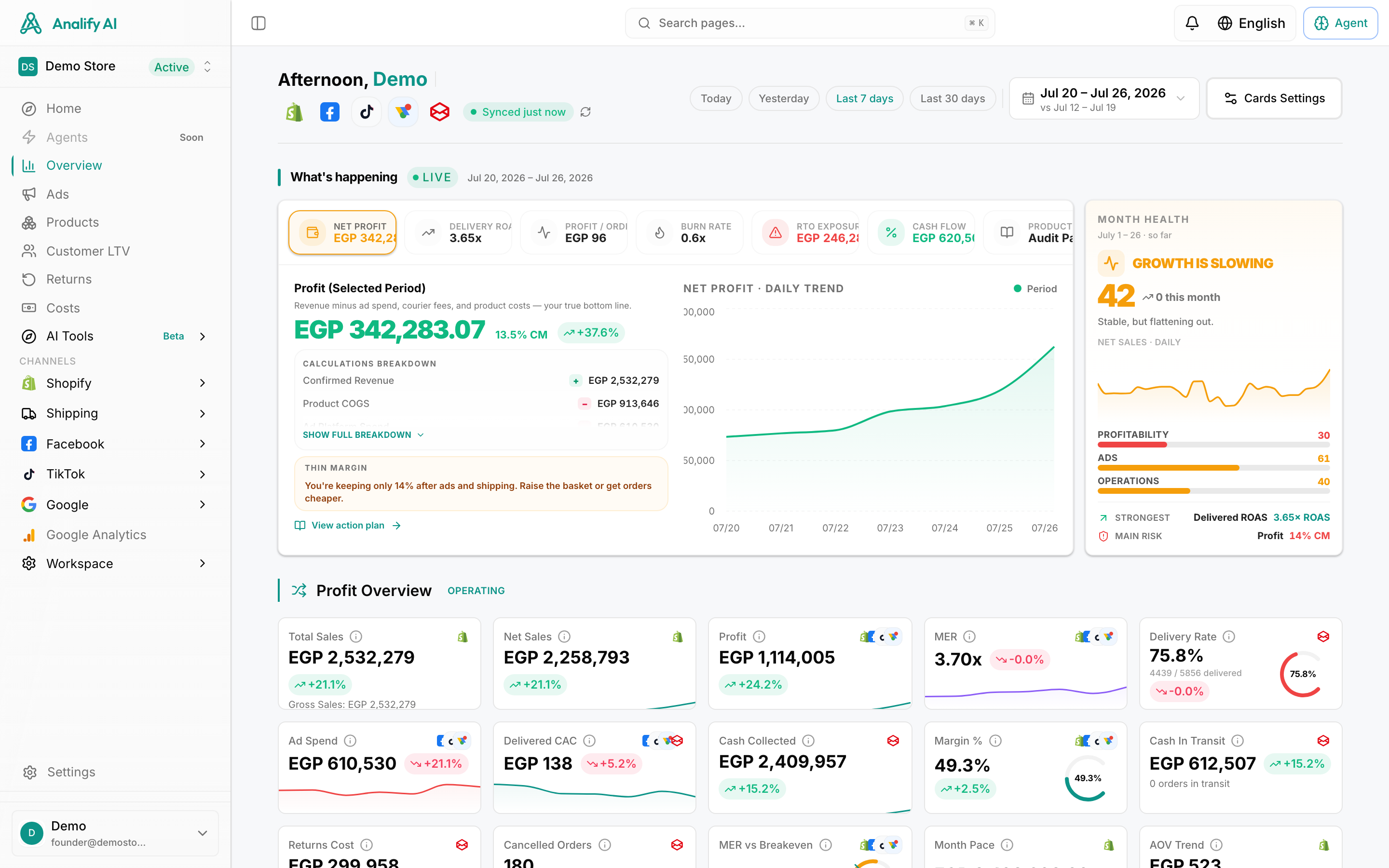
Why AI-Driven Advertising for Customer Segmentation Outperforms Traditional Methods
We get it – you've probably heard plenty of AI promises that didn't deliver. But the data on customer segmentation is pretty compelling, and here's why it actually works.
Enhanced Personalization at Scale
Traditional targeting treats your "women 25–45" segment as one homogeneous group. AI reveals that within that demographic, you actually have distinct micro-segments: "impulse buyers who respond to flash sales," "research-heavy customers who need social proof," and "brand loyalists who prefer exclusive access."
A fashion retailer we studied reduced cart abandonment from 68% to 51% by creating an AI-identified segment for "high-intent browsers" – customers who viewed 5+ products but hadn't purchased in 14 days. The AI recognized behavioral patterns that indicated strong purchase intent despite the delay, leading to targeted campaigns that converted at 3x the rate of generic retargeting.
This level of personalization matters because 80% of consumers are more likely to purchase from brands that provide personalized experiences. But here's the thing – you can't manually create personalized experiences for thousands of customers. AI makes it scalable.
Real-Time Dynamic Updates
Your customer behaviors change constantly, but traditional segments don't. That "millennial professional" segment you created six months ago? It's probably outdated. Maybe those customers have moved, changed jobs, or shifted their shopping habits entirely.
AI-driven advertising for customer segmentation adapts in real time. When the algorithm notices that your "weekend shoppers" segment is increasingly active on weekday mornings, it automatically adjusts. During the pandemic, AI systems identified "pandemic-shifted shopping patterns" without human intervention – recognizing that former in-store shoppers were now researching extensively online before purchasing.
This dynamic updating is crucial for Facebook targeting optimization because audience fatigue happens faster than ever. While you're manually checking campaign performance weekly, AI is already identifying when segments are becoming saturated and suggesting new micro-audiences to test.
Predictive Behavior Modeling
Here's where AI-driven advertising for customer segmentation gets really interesting for e-commerce: It doesn't just tell you what customers have done, but predicts what they'll do next.
Traditional segmentation is reactive – you target customers who have already shown interest. AI segmentation is predictive – it identifies customers who are likely to show interest based on behavioral patterns of similar users. This means you can:
- Target customers likely to churn before they show obvious signs
- Identify high-value prospects before competitors reach them
- Predict optimal timing for upsell campaigns
- Recognize seasonal behavior shifts before they fully manifest
The accuracy is impressive: AI-driven segmentation achieves 85% precision accuracy compared to 60% for traditional demographic approaches. That 25% improvement translates directly to better ad performance and lower acquisition costs.
Improved ROI and Conversion Rates
Let's talk numbers that matter to your bottom line. Companies using AI segmentation see an average 30% increase in marketing ROI compared to traditional demographic targeting.
But the real impact shows up in conversion rates. While traditional demographic targeting typically converts at 2–4%, AI-targeted campaigns regularly achieve 8–12% conversion rates. Some micro-segments perform even better – we've seen conversion rates double through AI-targeted promotions for highly specific behavioral segments.
The math is straightforward: If you're spending $10,000 monthly on ads with a 3% conversion rate, improving to 6% through AI-driven advertising for customer segmentation doubles your results with the same budget. That's an extra $10,000 in revenue monthly, minus the cost of the AI tool (typically $200–500/month).
Cross-Channel Consistency
One of the biggest advantages of AI-driven advertising for customer segmentation is creating a unified customer view across all your advertising platforms. Your "high-intent browsers" segment might perform differently on Facebook versus Instagram, or respond better to email campaigns than Google Ads.
AI identifies these cross-channel patterns automatically. For example, it might discover that your "price-sensitive repeat customers" convert best through Facebook retargeting but prefer email for initial product discovery. This insight lets you optimize budget allocation across channels based on where each segment performs best.
This cross-channel optimization becomes especially powerful when you integrate your audience targeting strategy across Meta, Google, and email platforms. Instead of managing separate audiences on each platform, you're working with consistent, AI-identified segments that perform predictably across channels.
How AI-Driven Advertising for Customer Segmentation Works
Now let's get into the mechanics of how this actually works for your e-commerce business. Don't worry – we'll keep this practical and skip the computer science lecture.
Data Collection and Integration
First, you need data. But here's the good news: you probably have more useful data than you think. The minimum requirements are pretty reasonable:
- Customer Records: At least 1,000 customer records (purchases, not just email signups)
- Behavioral Data: 6–12 months of customer interaction history
- Transaction Data: Purchase history with product details and values
Primary Data Sources:
- CRM System: Customer contact info, purchase history, support interactions
- Shopify Store: Product catalog, order details, customer lifetime value
- Meta Pixel: Website behavior, ad interactions, conversion events
- Google Analytics: Traffic sources, page views, session duration
- Email Platform: Open rates, click rates, engagement patterns
The key is connecting these data sources so the AI can see the complete customer journey. A customer might discover you through a Facebook ad, research on your website, abandon their cart, then convert through an email campaign. AI segmentation connects these touchpoints to understand the full behavioral pattern.
Pro Tip: Start with what you have. Even if your data isn't perfect, AI can work with incomplete information and improve as you add more data sources. The biggest mistake is waiting for "perfect" data that never comes.
AI Model Selection and Processing
Here's where the magic happens, but let's translate the technical stuff into practical terms.
**Unsupervised Learning (Pattern Discovery):**Think of this as the AI detective work. The algorithm looks at all your customer data without any preconceived notions and identifies hidden patterns. It might discover that customers who browse on mobile devices between 9–11 PM have completely different purchasing behaviors than desktop users, even if they're the same demographic.
The most common technique is called "K-means clustering," which is just a fancy way of saying "group customers with similar shopping patterns." The AI automatically determines how many groups make sense and what characteristics define each group.
**Supervised Learning (Prediction):**This is where AI gets predictive. Using historical data, the algorithm learns to predict outcomes. If you want to identify customers likely to make a repeat purchase, the AI analyzes patterns from customers who did make repeat purchases and applies those patterns to your current audience.
For e-commerce, this is incredibly powerful for machine learning algorithms that can predict:
- Purchase probability within specific timeframes
- Likely customer lifetime value
- Optimal timing for promotional campaigns
- Products customers are most likely to buy next
Segment Creation and Validation
Once the AI processes your data, it creates segments based on hundreds of data points simultaneously. Instead of manually deciding "let's target women 25–45," the AI might identify segments like:
- "Weekend Research Buyers": Browse extensively on weekends, purchase on weekdays, respond to detailed product information
- "Impulse Mobile Shoppers": Make quick decisions on mobile devices, prefer visual content, convert best with limited-time offers
- "Price-Conscious Loyalists": Compare prices extensively but stick with brands they trust, respond to exclusive discounts
Each segment comes with specific characteristics, behavioral patterns, and recommended messaging strategies. The AI doesn't just tell you who to target – it tells you how to target them.
Validation Process: Before you bet your ad budget on AI recommendations, smart platforms validate segments through:
- Statistical Significance Testing: Ensuring segments are large and distinct enough to matter
- Performance Prediction: Estimating likely conversion rates and ROI for each segment
- A/B Testing Framework: Comparing AI segments against your existing manual targeting
Dynamic Updates and Optimization
This is where AI-driven advertising for customer segmentation really shines compared to traditional methods. Your segments aren't static – they evolve as customer behaviors change.
Real-Time Adaptation:
- Customer moves from "price-sensitive" to "brand-loyal" based on purchase history
- Seasonal shoppers get reclassified as their behavior patterns shift
- New customers get assigned to segments as soon as enough behavioral data is available
**Automatic Budget Reallocation:**Advanced AI systems can automatically shift ad spend toward better-performing segments. If your "weekend browsers" segment suddenly starts converting at 2x the rate, the AI can increase budget allocation to that segment while reducing spend on underperforming audiences.
**Performance Learning:**The AI continuously learns from campaign results. If a segment performs better with video ads than image ads, or converts better on Instagram than Facebook, these insights get incorporated into future recommendations.
This dynamic optimization is particularly valuable for AI targeting for ads because it means your campaigns get smarter over time without manual intervention.
Real-World Results and Case Studies
Let's look at actual numbers from companies using AI-driven advertising for customer segmentation. These aren't theoretical improvements – they're real results from businesses similar to yours.
E-commerce Success Stories
**ASOS (Fashion E-commerce):**The global fashion retailer implemented AI-driven customer segmentation across their advertising campaigns and generated $77.5 million in incremental revenue. Their AI identified micro-segments based on style preferences, shopping frequency, and price sensitivity, enabling highly targeted campaigns that outperformed traditional demographic targeting by 340%.
**American Express:**While not pure e-commerce, their results are relevant for any business targeting consumers. American Express used AI segmentation for their advertising campaigns and achieved 2.5x higher engagement rates and 2x better campaign performance compared to traditional targeting methods.
**L'Oréal (Beauty E-commerce):**L'Oréal's AI segmentation strategy for their online beauty products resulted in a 22.22% conversion rate and 26.25% increase in click-through rates. They identified segments based on beauty routines, product preferences, and purchase timing to create highly relevant ad experiences.
The North Face (Outdoor Gear): By implementing AI-driven customer segmentation, The North Face achieved a 60% increase in click-through rates for their outdoor gear campaigns. Their AI identified segments based on activity preferences, seasonal shopping patterns, and gear upgrade cycles.
Before/After Performance Comparisons
Here's what typical performance improvements look like when switching from traditional demographic targeting to AI-driven advertising for customer segmentation:
Traditional Demographic Targeting:
- ROAS: 2.1x
- Conversion Rate: 3.2%
- Cost Per Acquisition: $45
- Customer Lifetime Value: $18
AI Segmentation Results (After 60 Days):
- ROAS: 3.4x
- Conversion Rate: 5.8%
- Cost Per Acquisition: $28
- Customer Lifetime Value: $240
Timeline for Results:
- Week 1–2: Initial segments created, testing begins
- Week 3–4: Early performance indicators show 15–20% improvement
- Week 5–8: Full optimization kicks in, achieving 30%+ improvements
- Month 3+: Compound improvements as AI learns from more data
ROI Calculations That Matter
Let's break down the actual investment and returns for a typical e-commerce business:
Monthly Investment:
- AI segmentation platform: $500/month
- Initial setup time: 10 hours (one-time)
- Ongoing management: 5 hours/month
Monthly Returns (Based on $10K Ad Spend):
- Traditional targeting revenue: $21,000 (2.1x ROAS)
- AI segmentation revenue: $34,000 (3.4x ROAS)
- Additional monthly revenue: $13,000
Payback Calculation:
- Additional revenue: $13,000/month
- Tool cost: $500/month
- Net monthly gain: $12,500
- Payback period: Immediate (first month)
These numbers are conservative based on the case studies above. Many businesses see even better results, especially once the AI has 6+ months of data to work with.
Analify AI — شاشة الـ media buyer مجاناً
بطّل تخمين أرقام الربح.
وصّل Shopify وMeta وTikTok وBosta في 5 دقايق.
ابدأ مجاناًStep-by-Step Implementation Guide
Ready to implement AI-driven advertising for customer segmentation for your e-commerce business? Here's your week-by-week roadmap to get from setup to results.
Week 1: Data Audit and Integration
Day 1–2: Inventory Your Data Sources Start by documenting what customer data you currently collect:
- Shopify customer records and order history
- Meta Pixel data and Facebook ad performance
- Google Analytics behavioral data
- Email marketing engagement metrics
- Customer service interactions and reviews
Day 3–4: Assess Data QualityCheck for common issues that can impact AI performance:
- Duplicate customer records
- Incomplete purchase data
- Missing product categorization
- Inconsistent tracking across devices
Day 5–7: Set Up Proper TrackingEnsure you're collecting the right data moving forward:
- Install or verify Meta Pixel implementation
- Set up Google Analytics 4 enhanced e-commerce tracking
- Configure Shopify customer data collection
- Implement server-side tracking if needed (especially important post–iOS 17)
Week 1 Deliverable: Complete data audit with identified gaps and tracking implementation plan.
Week 2–3: AI Platform Setup and Initial Segmentation
Choose Your Platform Based on Primary Advertising Channel:
- Meta-focused businesses: Analify offers the deepest Facebook advertising integration with AI Chat for instant campaign diagnostics
- Multi-channel businesses: Consider platforms that integrate with both Meta and Google
- Email-heavy businesses: Klaviyo provides strong AI segmentation for email marketing
Platform Setup Process:
- Connect Data Sources: Link your Shopify store, Meta account, and other platforms
- Import Historical Data: Upload at least 6 months of customer and transaction data
- Configure Tracking: Ensure new customer actions are properly captured
- Set Segmentation Goals: Define what outcomes you want to optimize for (ROAS, LTV, repeat purchases)
**Initial Segmentation Creation:**Allow the AI 7–14 days to process your data and create initial segments. During this time, continue running your existing campaigns – don't pause everything waiting for AI results.
Week 2–3 Deliverable: AI platform configured with initial customer segments ready for testing.
Week 4–6: Testing and Validation
Set Up A/B Testing Framework: Create parallel campaigns to compare AI segments against your existing targeting:
- Control Group: Your current best-performing manual targeting
- Test Group: AI-identified segments with identical ad creative and budget
- Budget Split: 50/50 initially, adjust based on early performance
Key Metrics to Track:
- Cost Per Acquisition (CPA) by segment
- Return on Ad Spend (ROAS) by segment
- Conversion Rate by segment
- Customer Lifetime Value by segment
Testing Requirements:
- Minimum Test Period: 30 days for statistical significance
- Minimum Budget: $1,000 per segment for reliable data
- Statistical Confidence: Wait for 95% confidence before making major decisions
Week 4–6 Deliverable: Validated AI segments with performance data proving improvement over manual targeting.
Week 7+: Optimization and Scaling
Performance-Based Budget Allocation:
- Pause underperforming segments that don't beat your control group after 45 days
- Increase budget for winning segments that show 20%+ improvement over manual targeting
- Expand successful segments to additional campaigns and ad formats
Ongoing Optimization Tasks:
- Weekly: Review segment performance and budget allocation
- Bi-weekly: Analyze new segments created by the AI
- Monthly: Conduct deeper analysis of customer lifetime value by segment
- Quarterly: Review overall strategy and platform performanc
**Scaling Strategies:**Once you have proven AI segments, expand them across:
- Additional Facebook and Instagram campaign types
- Google Ads campaigns (if your platform supports cross-channel segmentation)
- Email marketing campaigns with segment-specific messaging
- Retargeting campaigns with segment-specific creative
Success Metrics to Track Long-Term:
- Overall ROAS improvement: Target 25–40% increase within 90 days
- CPA reduction: Aim for 20–30% lower acquisition costs
- Segment stability: Ensure segments remain consistent and don’t fluctuate wildly
- Revenue attribution: Track incremental revenue directly attributable to AI segmentation
Meta Ads Integration
Custom Audiences From AI Segments: Upload your AI-identified segments as Custom Audiences in Facebook Ads Manager. This works particularly well for:
- Retargeting campaigns targeting specific behavioral segments
- Lookalike audience creation based on your highest-value AI segments
- Advantage+ campaigns where Meta’s algorithm can optimize within your defined segments
**Segment-Specific Creative Strategy:**Create ad variations tailored to each AI segment’s characteristics:
- "Sunday Evening Browsers" → urgency-focused creative with limited-time offers
- "Research-Heavy Customers" → detailed product information, comparison charts, and social proof
- "Impulse Mobile Shoppers" → bold visuals, simple messaging, mobile-optimized experiences
**Campaign Structure Optimization:**Instead of broad demographic targeting, structure campaigns around AI segments:
- Separate ad sets for each high-performing segment
- Budget allocation based on segment performance data
- Creative rotation testing within each segment
This approach works especially well when combined with audience targeting AI that can automatically optimize your Meta campaigns based on segment performance.
Shopify Integration
**Product Affinity Analysis:**AI-driven advertising for customer segmentation reveals which customer segments prefer which products, enabling:
- Cross-sell campaigns targeting segments likely to purchase complementary products
- Inventory-based targeting promoting products to segments with the highest purchase probability
- New product launches targeted to segments most likely to be early adopters
**Purchase Behavior Optimization:**Use AI segments to optimize the entire customer journey:
- Cart abandonment campaigns with segment-specific messaging and send-times
- Post-purchase upsells targeted to segments with high repeat purchase probability
- Retention campaigns for segments showing early churn signals
**Dynamic Segmentation:**Shopify integration enables real-time segment updates based on:
- Recent purchase behavior
- Product browsing patterns
- Seasonal shopping shifts
- Customer lifetime value changes
Email Marketing Enhancement
**Segment-Specific Email Sequences:**Create automated email flows tailored to AI-identified segments:
- Welcome series aligned with each segment’s behaviors and motivations
- Re-engagement campaigns targeted using segment-specific churn indicators
- Promotional campaigns customized with offers and timing optimized for each micro-segment
**Predictive Send-Time Optimization:**AI-driven advertising for customer segmentation can identify optimal email timing for each customer group:
- "Morning Commuter Shoppers" → 7–8 AM
- "Evening Browser Segment" → 7–9 PM
- "Weekend Researchers" → Saturday morning deep-dive content
**Dynamic Content Personalization:**Use segment data to personalize email content automatically:
- Product recommendations based on segment preferences
- Messaging tone that matches each segment’s communication style
- Visual design elements optimized for each segment’s response patterns
Platform Categories
All-in-One Advertising Solutions: