Discover how AI-driven advertising transforms behavioral targeting for e-commerce. Learn strategies and optimization techniques that boost ROI by 4x.
Picture this: You're spending $5,000 a month on Facebook ads, watching your budget drain while half of it goes to people who are less likely to convert. Sound familiar?
You're not alone – most e-commerce owners are throwing money at broad demographics instead of targeting the behaviors that actually predict purchases.
Here's what's interesting: the AI-driven advertising market just hit $29.8 billion****and is exploding as businesses realize they can significantly reduce customer acquisition costs with behavioral targeting. Meanwhile, Amazon's quietly using AI behavioral targeting to drive 35% of their total sales – and they're not exactly known for leaving money on the table.
The landscape is evolving. While you're still targeting "women aged 25-45 interested in fashion," experienced advertisers are targeting "users who browse product pages for 3+ minutes, add items to cart on mobile, and typically purchase within 48 hours of first visit." That's the difference between spray-and-pray advertising and improved precision.
This guide will walk you through exactly how to set up AI behavioral targeting that actually works – with platform-specific walkthroughs, budget examples from $1K to $20K+ monthly spend, and troubleshooting frameworks for when things go sideways. No fluff, just the implementation roadmap that's helping e-commerce brands significantly improve their advertising ROI.
What You'll Learn
- How to set up AI behavioral targeting on Meta and Google (with screenshots)
- Budget allocation strategies for $1K, $5K, and $20K+ monthly spend
- 27 ready-to-launch AI audience templates that convert
- Bonus: Troubleshooting guide when AI targets wrong demographics
What is AI-Driven Behavioral Targeting?
AI-driven behavioral targeting is the use of machine learning algorithms to analyze user actions, predict purchase intent, and automatically create audiences based on behavioral patterns rather than basic demographics.
Instead of targeting "25-year-old women," you're targeting "users who view product pages for 2+ minutes, engage with video content, and have purchase history in similar categories."
Here's the fundamental difference:
Targeting Comparison Table
Traditional Targeting AI Behavioral Targeting
Age, gender, interests Purchase patterns, engagement depth
Static audience segments Dynamic, self-optimizing audiences
Manual audience creation Automated pattern recognition
Broad reach, low precision Narrow reach, high precision
Standard conversion rates Improved conversion rates
The magic happens through three core technologies working together:
- Machine learning algorithms analyze millions of data points to identify patterns humans would never spot.
- Predictive analytics score users based on their likelihood to convert, not just their demographics.
- Real-time optimization continuously adjusts targeting as new behavioral data comes in.
The results are compelling: businesses using AI behavioral targeting see 4x higher click-through rates, improved conversion rates, and 52% reductions in customer acquisition costs.
But here's what most guides won't tell you: AI behavioral targeting isn't just about better performance – it's about sustainable scaling.
Traditional audiences get saturated and expensive. AI audiences evolve and improve as they collect more data, creating a compound effect that gets stronger over time.
For e-commerce specifically, this means targeting users based on:
- Cart abandonment patterns
- Product browsing depth
- Seasonal purchase timing
- Cross-category interests
It's the difference between casting a wide net and using a precision fishing line with the perfect bait.
Analify AI — شاشة الـ media buyer مجاناً
بطّل تخمين أرقام الربح.
وصّل Shopify وMeta وTikTok وBosta في 5 دقايق.
ابدأ مجاناً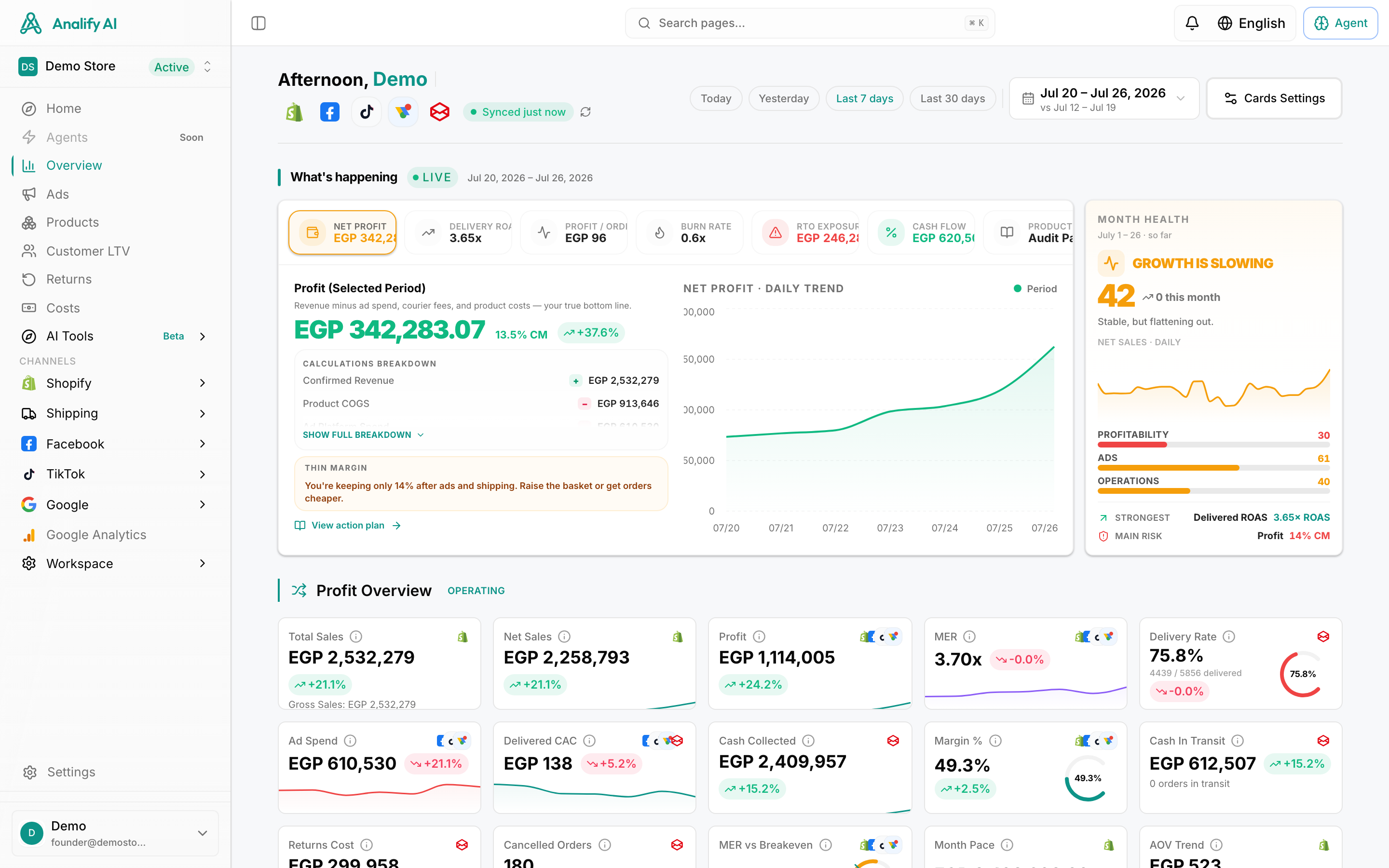
How AI Behavioral Targeting Works Behind the Scenes
Step 1: Data Collection
The AI gathers behavioral signals across your touchpoints: Meta pixel data, GA4 user journeys, Klaviyo engagement patterns, Shopify purchase behaviors, etc. The AI focuses on high-intent signals, not vanity metrics.
Step 2: Pattern Recognition
Machine learning identifies customer behavior clusters invisible to humans – e.g., "video viewers who revisit via mobile 48 hours later."
Step 3: Predictive Scoring
Users get scored through an eRFM model (enhanced Recency, Frequency, Monetary).
Step 4: Dynamic Audience Creation
AI builds real-time adaptive audiences that evolve as user behavior changes.
- Meta excels at social behavioral signals.
- Google excels at search + cross-device purchase intent.
Smart advertisers use both.
Pro Tip: Tools like Analify AI Chat let you ask questions like “Which behavioral audiences are converting best this week?” and get instant, data-backed answers.
Platform-Specific Implementation Guide
Meta Advantage+ Behavioral Targeting
Step 1: Campaign Structure
Use "Conversions" → Advantage+ audience → behavioral suggestions (not restrictions).
Step 2: Behavioral Signal Inputs
- Custom Audiences (buyers, add-to-carts, PDP viewers)
- Lookalikes (1%-5%)
- Engagement audiences (video viewers, IG engagers)
Budget Allocation Strategies
- 70% retargeting (30-day visitors)
- 30% 1% Lookalike
Simple, profitable, low-risk.
- 40% retargeting
- 40% warm (LLAs + engagers)
- 20% cold Advantage+ expansion
Separate full-funnel campaigns:
- $6K retargeting
- $8K warm audiences
- $6K cold acquisition
Cleaner data + higher scaling efficiency.