Master the playbook for advertising professionals. Learn to automate reporting, master CAPI, and scale clients with AI in a zero-click world. Get the framework.
For many advertising professionals, juggling 20 client accounts feels like trying to solve 20 different escape rooms at once, doesn't it? We've all been there.
Just when you’ve finally cracked one platform’s algorithm, Google unleashes AI Overviews. Suddenly, according to recent industry analysis, nearly 60% of searches go "zero-click." Then your clients start asking about "agentic commerce," and you're left nodding along while frantically Googling under the table.
We get it. The old agency model is broken. To survive and thrive, advertising professionals and their agencies must become efficiency engines. We need to integrate generative AI, champion community-led authenticity, and master commerce media to drive revenue that we can actually prove.
But here’s the thing: this isn't another fluffy, high-level trend report. This is the practical, step-by-step playbook for advertising professionals looking to scale client results and their agency's bottom line in this new era.
Here's What We'll Cover
- We'll show you how to adapt your agency's strategy for a "zero-click" SERP and AI Overviews.
- You'll get the step-by-step process to automate multi-channel client reporting (and save hours per week).
- We'll walk through how to fix attribution gaps and boost data accuracy using CAPI integration.
- You'll get a proven framework for scaling agency operations with AI that goes way beyond just content creation.
- Bonus: We've included a checklist for building an AI-ready agency team structure.
The New Reality: Thriving in a Zero-Click, AI-First World
This isn't a passing fad; it's the new normal. The ground has shifted beneath our feet, and understanding this new landscape is the first step to conquering it together.
The global advertising market is projected to hit a staggering $1.14 trillion in 2025. And with 75% of that spend coming from mobile, the battle for attention is happening on a 6-inch screen.
So, What Exactly is "Zero-Click Search"?
It’s exactly what it sounds like. A user asks Google a question, and the AI-powered answer appears directly on the search results page. The user gets their info and never clicks through to a website.
That 60% statistic****is a massive wake-up call for agencies that have relied on SEO and organic traffic for decades. It means our clients' websites are no longer the final destination; they're just one data source among many for the AI.
Meet Your New Gatekeeper: Agentic Commerce
Get ready for this one. Agentic commerce is where AI agents (think of them as super-smart personal assistants) will make purchases on behalf of users based on their preferences and past behavior.
Instead of a user browsing your client's site, they’ll just say, "Hey AI, find me the best eco-friendly running shoes for under $150." The AI will then crawl product feeds, reviews, and social sentiment to make the purchase. This makes having a clean, optimized product feed and consistent brand messaging more critical than ever.
Pro Tip: Start optimizing for "Digital Scent." Basically, it just means making sure your client's brand voice, product details, and unique selling propositions are crystal clear and consistent across every single platform—from your Facebook advertising campaigns to your TikTok descriptions. AI models will use this "scent" to learn about and accurately represent your client's brand.
Analify AI — شاشة الـ media buyer مجاناً
بطّل تخمين أرقام الربح.
وصّل Shopify وMeta وTikTok وBosta في 5 دقايق.
ابدأ مجاناً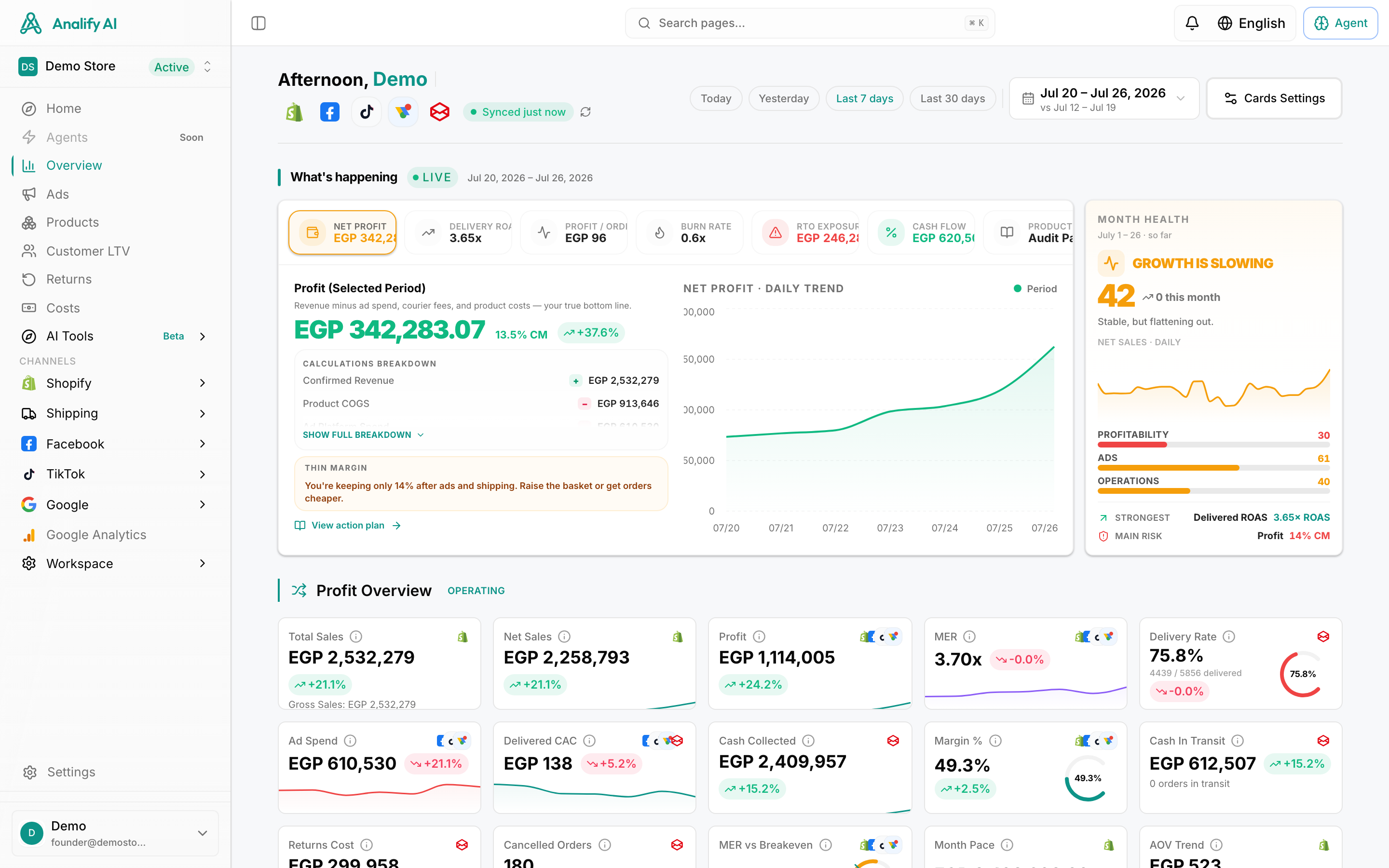
The Agency Reporting Revolution: Automating Client Trust
Client demands for transparency are at an all-time high, but your team's time is your most valuable (and expensive) resource. Manual reporting is a profit-killer, plain and simple.
The Multi-Platform Nightmare
Sound familiar? It’s the end of the month. To build a single client report, your account manager has to log into Facebook Ads Manager, Google Ads, TikTok Ads, GA4, and Shopify.
They download five different CSVs, fight with spreadsheet formulas, and spend half a day trying to stitch it all together into something that looks professional. It’s a soul-crushing, inefficient process that drains your profitability.
The Solution: Unified Live Dashboards
The future of client reporting is automated, live, and unified. Imagine giving each client a single, branded link to a dashboard that shows their blended ROAS, MER, and net profit in real-time, pulling data from all their active channels.
This isn't a fantasy; it's what top agencies are doing right now. This is especially crucial as commerce media is projected to hit $178.2 billion in global ad revenue in 2025, surpassing TV ad revenue. Your clients need a single source of truth for their commerce performance.
Quick Tip: Use a tool like the reporting tool to quickly generate a comprehensive, cross-channel performance summary. Before every client call, you can create a beautiful, easy-to-understand report that combines data from Meta, Google, TikTok, GA4, Shopify, and Klaviyo. It’s a powerful way to optimize ad spend across platforms and prove your agency's value without the manual headache.
Fixing the Signal: A Practical Guide to CAPI Integration
iOS updates, cookie deprecation, and ad-blockers have punched massive holes in our attribution. Relying solely on the Facebook pixel is like trying to navigate a ship with a broken compass.
Server-side tracking is no longer a "nice-to-have"; it's a must-have for any serious agency.
CAPI vs. The Pixel: A Simple Explanation
Here’s how you can explain it to clients without their eyes glazing over:
- The Pixel (Browser-Side): It’s like a scout that lives in the user's web browser. It watches what they do on the website and sends reports back to Facebook. But, it can be easily blocked by iOS privacy settings or ad blockers.
- The Conversions API or CAPI (Server-Side): This is like having a direct, secure phone line from your client's website server to Facebook's server. It sends data directly, bypassing the browser, so it's far more reliable and accurate.
5 Steps to Implement CAPI for Your Clients:
- Choose Your Method: Decide if you'll use a partner integration (like Shopify or Analify) or a direct integration (which requires a developer). Trust us, for most agencies, a partner integration is the way to go—it's faster and way less of a headache.
- Generate an Access Token: Inside your client's Facebook Events Manager, generate a unique CAPI access token.
- Set Up the Integration: Follow the instructions from your chosen partner to connect the website server to Meta using the access token. Analify Server-Side Tracking is included in our standard plan and simplifies this process immensely.
- Enable Event Matching: Ensure you're passing back key customer parameters (like email and phone number, hashed for privacy) to help Facebook match server events to user profiles.
- Test and Verify: Use the "Test Events" tool in Events Manager to confirm that your server events are being received and deduplicated correctly against your pixel events. Pro Tip: Frame CAPI to clients as "future-proofing their data." It's not just a technical fix; it's a strategic investment in accurate measurement that will give them a competitive edge for years to come.
Scaling Operations with Agentic AI & Automation
The smartest agencies are using AI for a lot more than just writing ad copy. They're using it as an analytical partner to automate diagnostics, find optimization opportunities, and scale their e-commerce strategies.
Beyond Generative Copy
Generative AI is great, but its real power for agencies lies in performance analysis. Imagine being able to diagnose a sudden conversion drop without spending hours digging through Ads Manager. What if you could just ask a question and get an answer?
This is where agentic AI comes in. These are AI systems designed to perform tasks and provide insights. Instead of just generating text, they analyze data and recommend actions.