Discover the 10 best growth marketing automation platforms to scale your business. We compare Analify, HubSpot, Klaviyo & more on AI, pricing, and ROI.
You’ve got a dozen tabs open, five platforms running, and your data looks like a plate of spaghetti. Sound familiar?
We’ve moved way past the era of quick “growth hacks.” Today, real growth comes from structured, data-driven systems that actually work together.
The problem is, most teams are stuck in tool bloat and messy data silos. And that chaos doesn’t just slow you down—it quietly eats into your revenue.
So think of this guide as your reset. We’re cutting through the noise and showing you the platforms that actually help you automate growth, simplify your stack, and scale ROI without the headache.
What is Growth Marketing Automation?
Growth marketing automation is the use of software to manage, automate, and measure data-driven marketing tasks across the entire customer lifecycle, moving beyond simple workflows to orchestrate complex growth frameworks that prioritize customer lifetime value (CLV).
Let’s be honest, for years "marketing automation" just meant setting up a welcome email sequence. Cute, but not exactly a growth engine, right? Today, we’re talking about something much bigger.
We’re shifting our focus from one-off campaigns to building systems that increase customer lifetime value (CLV). It’s about orchestrating the entire journey, from the first ad impression to the tenth purchase.
So, who's the biggest villain in this story? Data silos. When your ad platform, your email tool, and your store analytics don't talk to each other, you're flying blind. It’s not just an inconvenience; it’s a massive financial drain. According to Guideflow, failing to integrate tools can cost organizations between 20% and 30% of their annual revenue. Ouch.
True growth automation breaks down those walls, giving you a single, unified view of what’s actually working.
How to Choose a Growth Marketing Platform: 4 Key Criteria
Before we dive into the list, let’s get on the same page. With so many tools promising the world, how do you actually evaluate them without getting distracted by shiny objects? We’ve seen it all, and we’ve boiled it down to four non-negotiable criteria. Understanding the core features of marketing automation software is the first step. Seriously, use this as your checklist.
1. Data Infrastructure & Integration
Does the platform unify your data, or does it just create another silo? The goal is a single source of truth. You need a tool that can pull in data from all your key channels—Meta, Google, TikTok, Shopify, GA4—and present it in one coherent view. This is why we built the Business Dashboard into Analify; it stops you from having to play "data detective" across five different tabs just to figure out your blended ROAS.
2. AI & Orchestration Capabilities
Is the platform truly AI-native, or is it just "AI-washed"? We've all seen the "AI FOMO" driving tech trends, where every other software slaps an "AI" label on a simple rules-based feature. True AI doesn't just follow "if-then" rules. It analyzes data, identifies patterns humans would miss, and provides strategic recommendations. It should act as your co-pilot, not just a glorified calculator.
3. Total Cost of Ownership (TCO)
What's the real cost beyond the sticker price? This is where many businesses get burned. A platform might seem cheap, but then you get hit with contact-based pricing that skyrockets as you grow. Look for transparent pricing models (like Analify ad-spend-based tiers) that scale with your success, not penalize you for it.
4. E-commerce Specialization
Is it built for transactional data or just lead forms? B2B and e-commerce are two different worlds. E-commerce growth depends on granular, event-level data, real-time ad optimization, and a deep understanding of metrics like ROAS and cost per purchase. A generic B2B platform simply can't optimize for the fast-paced, transactional nature of selling products online.
Analify AI — free media buyer view
Stop guessing your profit.
Connect Shopify, Meta, TikTok and Bosta in 5 minutes.
Start free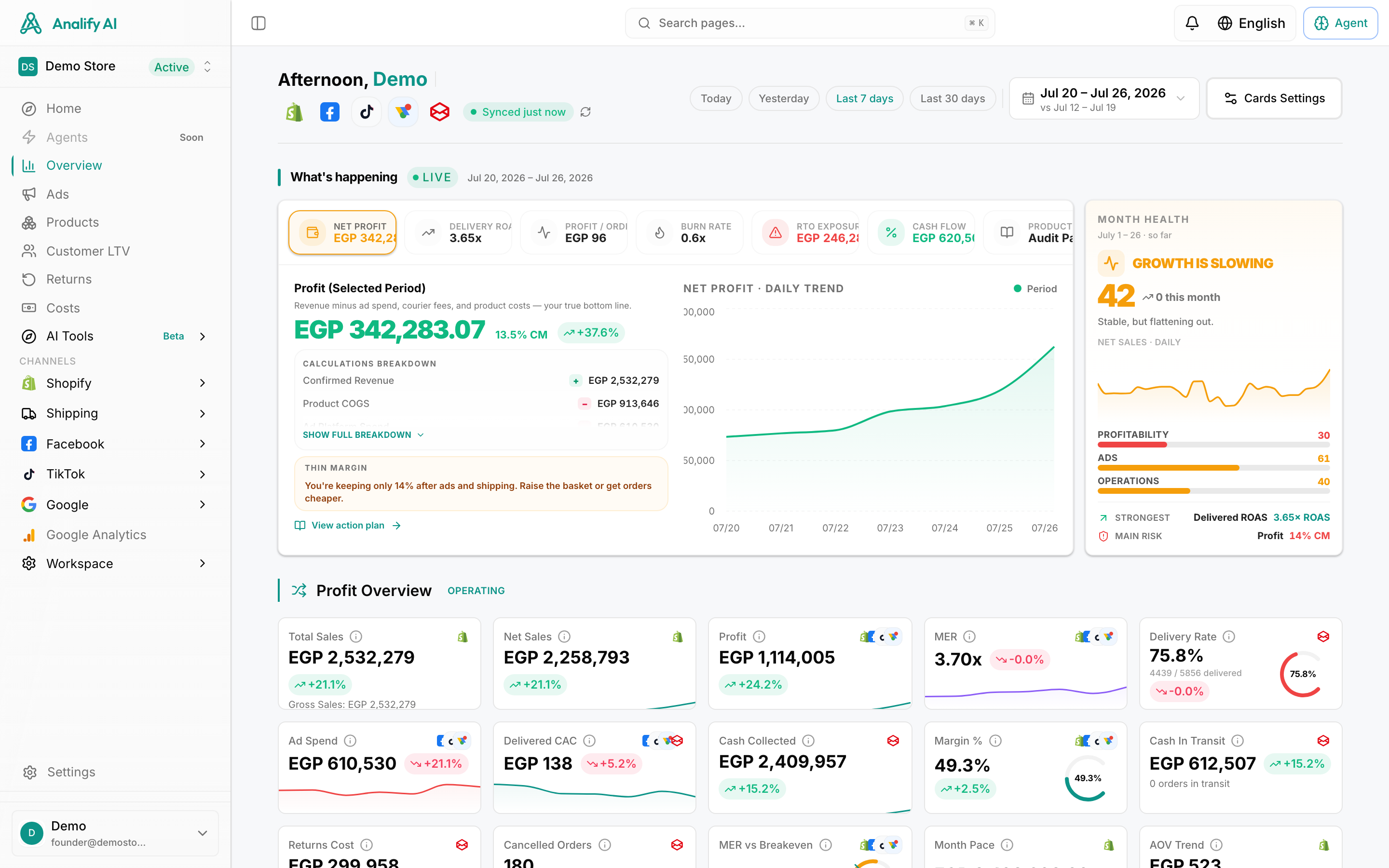
The 10 Powerful Growth Marketing Automation Platforms
Alright, let's get to the main event. We put dozens of tools to the test using our checklist above. Here are the 10 that truly deliver on the promise of automated growth.
Platform Best For Key Differentiator Pricing Model
1. Analify E-commerce Scaling AI Creative + Ad Optimization + Analytics Tiered (based on ad spend)
-
Klaviyo E-commerce Email & SMS Granular segmentation & data model Contact-based
-
HubSpot B2B Inbound Marketing All-in-one CRM & marketing suite Tiered (high TCO)
-
Customer.io SaaS & Tech Behavioral messaging workflows Profile-based
-
Zapier Custom Stacks Universal app connection (6,000+ apps) Task-based
-
ActiveCampaign B2B & E-commerce Hybrid Advanced automation builder Contact-based
-
Gumloop AI-Native Workflows Building custom AI agents & flows Credit-based
-
Clay Outbound Prospecting Data enrichment & sales automation Credit-based
-
Omnisend SMB E-commerce Email, SMS, & Push in one platform Contact-based
-
Brevo Startups & Small Business High-value free tier & affordability Email volume-based
1. Analify
Best for: E-commerce businesses focused on scaling revenue with paid ads.
Okay, full disclosure: this is our home turf. We built Analify because we were tired of the exact problems we've been talking about. While other tools handle one piece of the puzzle, we connect the dots between creating ads, optimizing them for profit, and analyzing the results across all your channels.
It starts with creative. Our AI Ad Generator helps you produce thumb-stopping image ads in seconds, ending the creative bottleneck for good. Then, our AI Marketer steps in, acting as your 24/7 optimization co-pilot. It audits your account daily, provides one-click budget optimization recommendations, and helps you scale winners and cut losers.