Tired of manual reporting? Discover the best automated reporting tools for agencies. Save 10+ hours a week, eliminate errors, and boost client retention.
Tired of spending hours on manual reports? Automated reporting tools are software platforms that connect to your data sources (like Meta and Google Ads), build dynamic dashboards, and schedule report delivery. They save agencies an average of 10+ hours per week by eliminating manual data entry, reducing errors, and providing clients with real-time access to performance insights.
You know the drill. Your best account manager spends hours pulling data from Facebook Ads, Google Ads, Shopify, and GA4 for ten different clients. It's tedious, soul-crushing work, prone to copy-paste errors, and by the time the beautiful (but static) PDF is ready, the data is already stale.
Sound painfully familiar? You're not alone. Agencies waste hours a month on this exact task. In fact, some studies find that agencies report a75% reduction in manual workafter making the switch.
The market is flooded with options. From heavy-duty BI platforms to slick, marketing-focused dashboards, how do you choose the right one for your agency's specific workflow, client needs, and budget?
Don't you worry. We've done the heavy lifting for you. In this guide, we're going to break down the top 10 tools, show you exactly how to calculate the ROI for your agency, and even give you a 4-week plan to get started. Let's get those hours back.
Here's the Game Plan
We're not just throwing a list at you. Here's what we're going to cover together:
- First, we'll show you how to realistically save over 10 hours a week on client reporting.
- Then, we'll dive into a feature-by-feature comparison of the top 10 reporting tools.
- We'll give you a simple formula to calculate the exact ROI of automation for your agency.
- Bonus: We've included a step-by-step 4-week implementation plan so you can get started right away.
What Are Automated Reporting Tools?
Let's get on the same page. Automated reporting tools are applications that connect to various data sources (like Facebook Ads, Google Analytics, and Shopify), pull data via APIs, and display it in a unified, easy-to-understand dashboard or report.
Basically, instead of you manually exporting CSVs and pasting them into a spreadsheet, these tools do all the heavy lifting for you in real-time.
Pro Tip: The goal isn't just to automate reports; it's to automate insights. The right tool doesn't just show you numbers; it helps you spot trends, identify opportunities, and make smarter decisions faster. It's the difference between looking at a map and having a GPS tell you the best route.
To really drive it home, let's look at the difference between the old way and the new way.
Aspect
Manual Reporting
Automated Reporting
Time per report
4.5–9 hours
Minutes (after setup)
Error rate
High (human input)
Minimal (system-driven)
Real-time data
No
Yes
Scalability
Limited
High
Why Your Agency Needs Automated Reporting (The Real ROI)
Switching to an automated system isn't just a "nice-to-have" upgrade; it's a fundamental business decision with a massive return on investment. Let's break down the actual value.
1. Massive Time Savings
This is the most obvious one, but it's worth repeating. The data is clear: automated reporting saves 8-10 hours per week per report.
Let's do some quick math. If your analyst's time is worth a conservative $27/hour, saving 8 hours a week is $216. Over a year, that's $11,232 in annual cost savings per report. Now multiply that by your number of clients. You're freeing up hundreds of hours for your team to focus on strategy, optimization, and client relationships—the stuff that actually grows your agency.
2. Improved Accuracy and Trust
Let's be honest, we've all made a copy-paste error that threw a whole report into question. Manual reporting is a minefield of potential mistakes.
Automation eliminates human error by pulling data directly from the source. This means your team and your clients can trust the numbers, leading to more productive conversations about strategy instead of nitpicking data discrepancies.
3. Enhanced Client Retention
Clients love transparency and professionalism. Sending a slick, real-time dashboard that they can access anytime screams "we've got this." It showcases the value you're providing 24/7, not just in a weekly email. This level of service is a powerful retention tool that separates you from agencies still sending clunky spreadsheets.
4. True Scalability
With manual reporting, every new client adds a significant time burden to your team. With automation, onboarding a new client is as simple as connecting their data sources to a pre-built report template. You can take on more business without proportionally increasing your overhead. This is how you scale profitably.
The numbers back this up. Studies show that marketing automation can deliver an average of $5.44 for every $1 spent, representing a staggering 544% ROI. With 77% of marketing agencies already reporting AI adoption, falling behind isn't an option.
Analify AI — free media buyer view
Stop guessing your profit.
Connect Shopify, Meta, TikTok and Bosta in 5 minutes.
Start free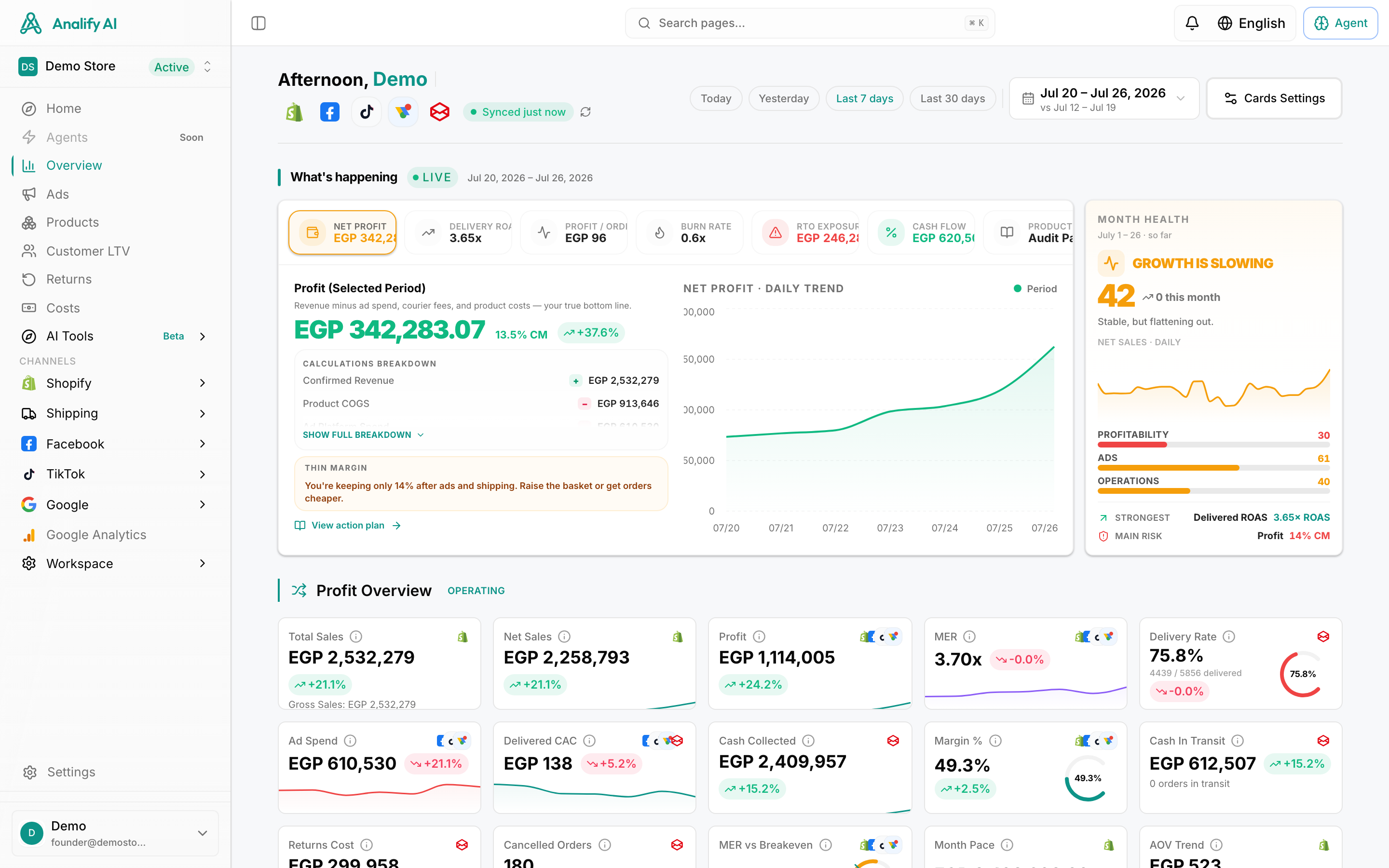
Types of Automated Reporting Tools
Not all reporting tools are created equal. They generally fall into three main categories, so let's figure out which one is right for you.
- **Business Intelligence (BI) Platforms:**Think of these as the heavy-duty power tools. Platforms like Tableau and Power BI are designed for deep, custom analysis. They can connect to almost any data source but often require a dedicated analyst to manage.
- **Marketing-Specific Reporting Tools:**These are purpose-built for agencies like yours. Tools like AgencyAnalytics and Whatagraph come with pre-built integrations for all major marketing channels and offer easy-to-use, drag-and-drop report builders.
- **Integrated Ad Platforms:**This is a newer, more powerful category. An integrated platform like Analify doesn't just handle reporting; it combines it with campaign management and optimization. The reporting is built directly into the tool you use to manage ads, creating a seamless workflow from insight to action.
Top 10 Automated Reporting Tools for Agencies
Alright, let's get to the main event. We've analyzed dozens of platforms to bring you the definitive list, with a special focus on what works for agencies.