Discover the best tools for marketing to build a lean tech stack. Our guide covers 12 top tools for AI, analytics, and automation to scale results, not costs.
Ever feel like your day is just a frantic dance between a dozen different software tabs? One for analytics, another for client comms, three for social scheduling, one for your CRM, and a spreadsheet that’s literally groaning under the weight of a million VLOOKUPs.
If that sounds familiar, you’re not alone. The best business tools for marketing aren't just about adding more software; they're about building an integrated and intelligent tech stack. This involves consolidating platforms for AI-augmented analytics, client management (CRM), and multi-channel automation to improve efficiency, cut costs, and scale results. This shift is central to the future of AI in digital marketing.
This guide isn't another overwhelming list of 50 tools you "must have." It's a consolidation plan. We're going to help you audit what you have, ditch what you don't need, and build a leaner, more profitable marketing tech stack that impresses clients and empowers your team.
What You'll Learn
- How to audit and consolidate your current tech stack to cut costs.
- The core tools that form the foundation of a scalable business.
- How to use AI for content creation that doesn't sound like a robot.
- The secret to streamlined client reporting that builds trust and transparency.
- Bonus: A "Tool Decommissioning Checklist" to safely migrate away from software that no longer serves you.
The Modern Marketing Challenge: From Tool Sprawl to a Lean Stack
It's no longer enough to be good at running ads or writing copy. We have to be tech integrators, data scientists, and efficiency experts. The pressure is on, and the old way of just slapping another tool onto the pile to solve every new problem is breaking.
The rise of AI isn't just a trend; it's a fundamental shift. According to a recent study by Typeface, 53% of marketing leaders have already reorganized their teams or updated roles because of AI. This isn't about replacing people; it's about augmenting them with a smarter, more connected set of tools.
This is where the concept of "Workflow Architecture" comes in. It’s a fancy way of saying your marketing tools should talk to each other. Your CRM should inform your ad targeting. Your ad performance data should flow seamlessly into your client reports. Your project management tool should trigger actions in your communication apps.
When your stack is a tangled mess, you're leaking time, money, and opportunity. But when it's a clean, integrated architecture? You create a flywheel that makes your agency faster, smarter, and way more scalable.
Pro Tip: The One-Question Audit
Before you add any new tool, ask yourself: "Does this replace an existing tool or add a genuinely new capability we don't have?" If it just adds another layer of complexity, walk away.
To help you get started, here’s a simple checklist for auditing and cleaning house.
Your Tool Decommissioning Checklist
Thinking of breaking up with a piece of software? We get it. But it’s not always as simple as clicking "cancel subscription." Follow these steps to avoid total chaos.
- Identify the Redundancy: Which tool is the weakest link? Is its core function covered better by another tool in your stack?
- Plan Your Data Migration: Where will the data from the old tool live? Export all historical data (client info, reports, assets) before you lose access.
- Announce the Change Internally: Give your team a clear timeline. Explain why the change is happening (e.g., "We're moving to Tool Y because it will save us 5 hours a week on reporting").
- Update Your Workflows: Document the new process. Where do people go now for that specific task? Update your SOPs.
- Run Both Tools in Parallel (1-2 Weeks): For critical functions, have a short overlap period. This lets you work out the kinks in the new system without interrupting client work.
- Pull the Plug: Once the new workflow is stable, cancel the old subscription. And hey, enjoy that little bump in your profit margin!
Analify AI — free media buyer view
Stop guessing your profit.
Connect Shopify, Meta, TikTok and Bosta in 5 minutes.
Start free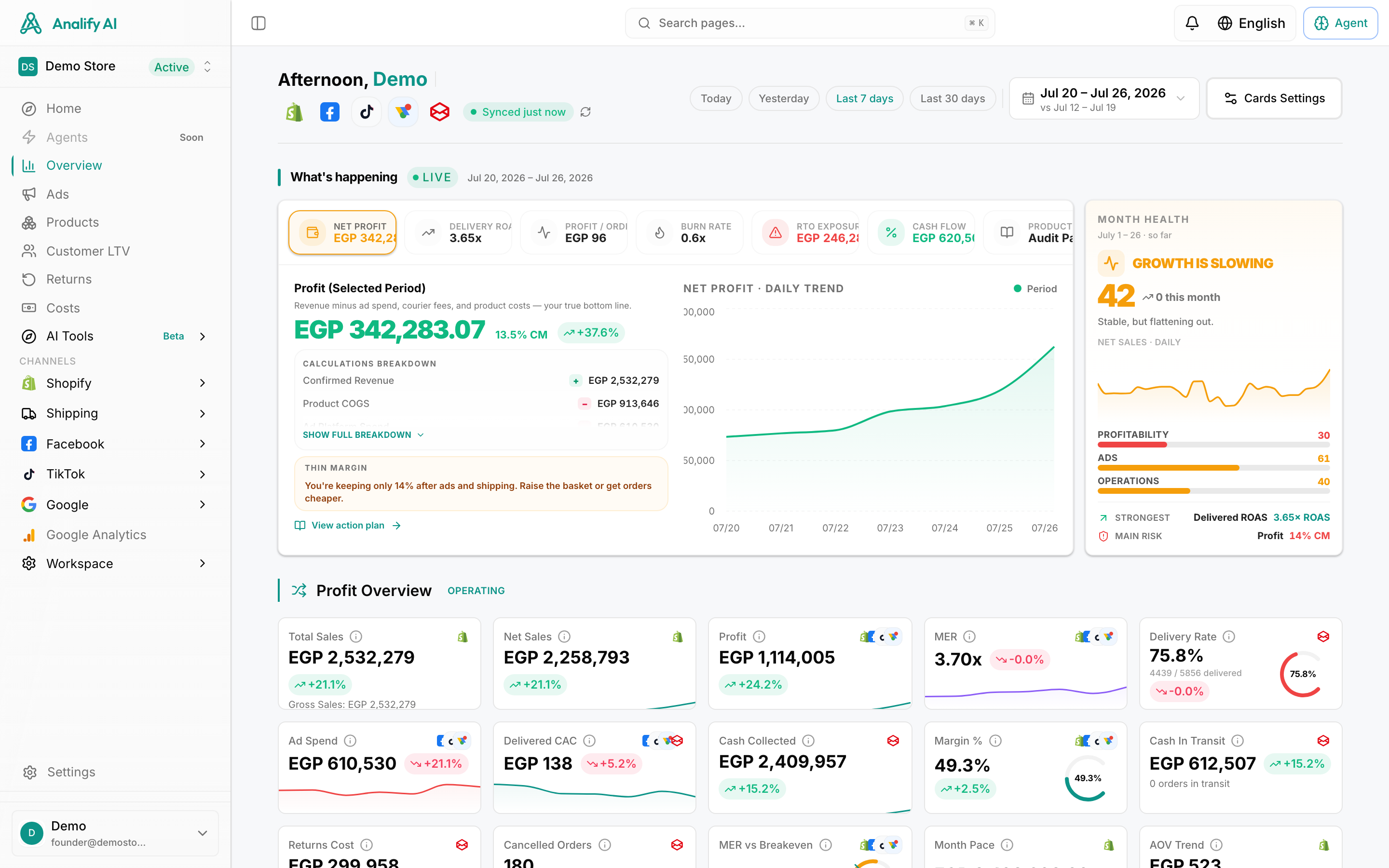
Core Foundation: The Client "Source of Truth" (CRM)
Every scalable business needs a central nervous system—a single place where all client information, communication, and deal flow lives. This is your CRM. It’s not just a fancy address book; it’s the foundation of your entire operation.
1. HubSpot
We’re starting here because if you get this right, everything else becomes easier. HubSpot has evolved from an inbound marketing tool to a full-fledged CRM platform that can run your entire front office.
Why it’s essential:
- Client Hub: It’s your "source of truth" for every client interaction, from the first discovery call to the final invoice.
- Sales Pipeline: Manage your own growth by tracking leads and deals in a clean, visual pipeline.
- Data for Ads: This is the secret sauce. You can use your client data to create powerful custom audiences on platforms like Meta, targeting high-value lookalikes or re-engaging past customers.
A recent report from Salesforce found that 83% of sales teams with AI saw revenue growth. A good CRM doesn't just store data; it helps you use it to make more money.
- Pricing: HubSpot offers free tools, with its Starter plan beginning at $20/month.
Performance & Analytics: From Data Overload to Instant Insights
If the CRM is your heart, the analytics platform is your brain. This is where you prove your value, diagnose problems, and find scaling opportunities. The goal here is to move from data collection to insight generation as quickly as possible.
2. Analify
Analify was built to be the performance and analytics hub for agencies and e-commerce brands. It’s designed to eliminate manual, time-sucking tasks.
Why it’s essential: