Compare top attribution platforms for performance marketers. Expert analysis of AI-powered tools, tracking, and privacy-compliant solutions that work.
Picture this: Your customer clicked a Facebook ad, watched a YouTube video, read three blog posts, opened two emails, and finally converted through a Google search. Which channel gets credit for the $500 sale? If you're scratching your head, you're not alone.
Here's the kicker – 70% of companies are using multi-touch attribution, yet 68% of top-performing marketers rely on advanced algorithmic models to actually understand what's driving their results. That gap? It's costing performance marketers serious money.
As someone who's been in the trenches optimizing campaigns, I know the frustration of staring at conflicting data across platforms. Facebook says it drove 40% of conversions, Google claims 35%, and your email platform swears it's responsible for 25%. The math doesn't add up, your budget allocation is a mess, and you're making optimization decisions based on incomplete data.
This comprehensive guide breaks down the 15 best attribution platforms for performance marketers in 2025. We'll dive deep into technical capabilities, implementation complexity, and real-world performance – because you need solutions that actually work, not just pretty dashboards.
What You'll Learn
By the end of this guide, you'll have everything needed to build a bulletproof attribution strategy:
- 15 attribution platforms ranked by technical capabilities and performance marketer needs
- Server-side tracking implementation strategies for iOS 14+ compliance
- Data-driven vs rule-based attribution models with specific use cases
- Integration complexity ratings and realistic implementation timelines
- Bonus: Attribution audit checklist and troubleshooting decision tree
Attribution Modeling Fundamentals for Performance Marketers
Let's cut through the marketing fluff and get technical. Attribution modeling is the systematic approach to assigning conversion credit across multiple customer touchpoints using data-driven algorithms or predefined rules.
Here's what actually matters for performance marketers:
Single-Touch Attribution assigns 100% credit to one touchpoint (first-click or last-click). It's simple but wildly inaccurate for multi-channel campaigns. Use it only when you're running single-channel campaigns or need quick directional insights.
Multi-Touch Attribution (MTA) distributes credit across multiple touchpoints using various models – linear, time-decay, position-based, or custom weighting. This gives you a more realistic view of the customer journey but requires significant data volume to be meaningful.
Data-Driven Attribution uses machine learning to analyze conversion patterns and assign credit based on actual impact, not predetermined rules. Advanced attribution models can lead to 15-30% reduction in CAC and up to 40% improvement in marketing ROI, but you need substantial conversion volume (typically 1,000+ conversions per month) for the algorithms to work effectively.
Attribution Model Selection Framework
Attribution Model Recommendations
Data Volume Channel Complexity Recommended Model Implementation Priority
<500 conversions/month 1-2 channels Last-click + platform native Low
500-1,000 conversions/month 2-4 channels Rule-based MTA Medium
1,000+ conversions/month 3+ channels Data-driven MTA High
5,000+ conversions/month 5+ channels Custom algorithmic Critical
The reality? Most performance marketers are stuck in the middle – enough complexity to need better attribution, but not enough data volume for advanced models to work properly. That's where specialized platforms come in.
Analify AI — free media buyer view
Stop guessing your profit.
Connect Shopify, Meta, TikTok and Bosta in 5 minutes.
Start free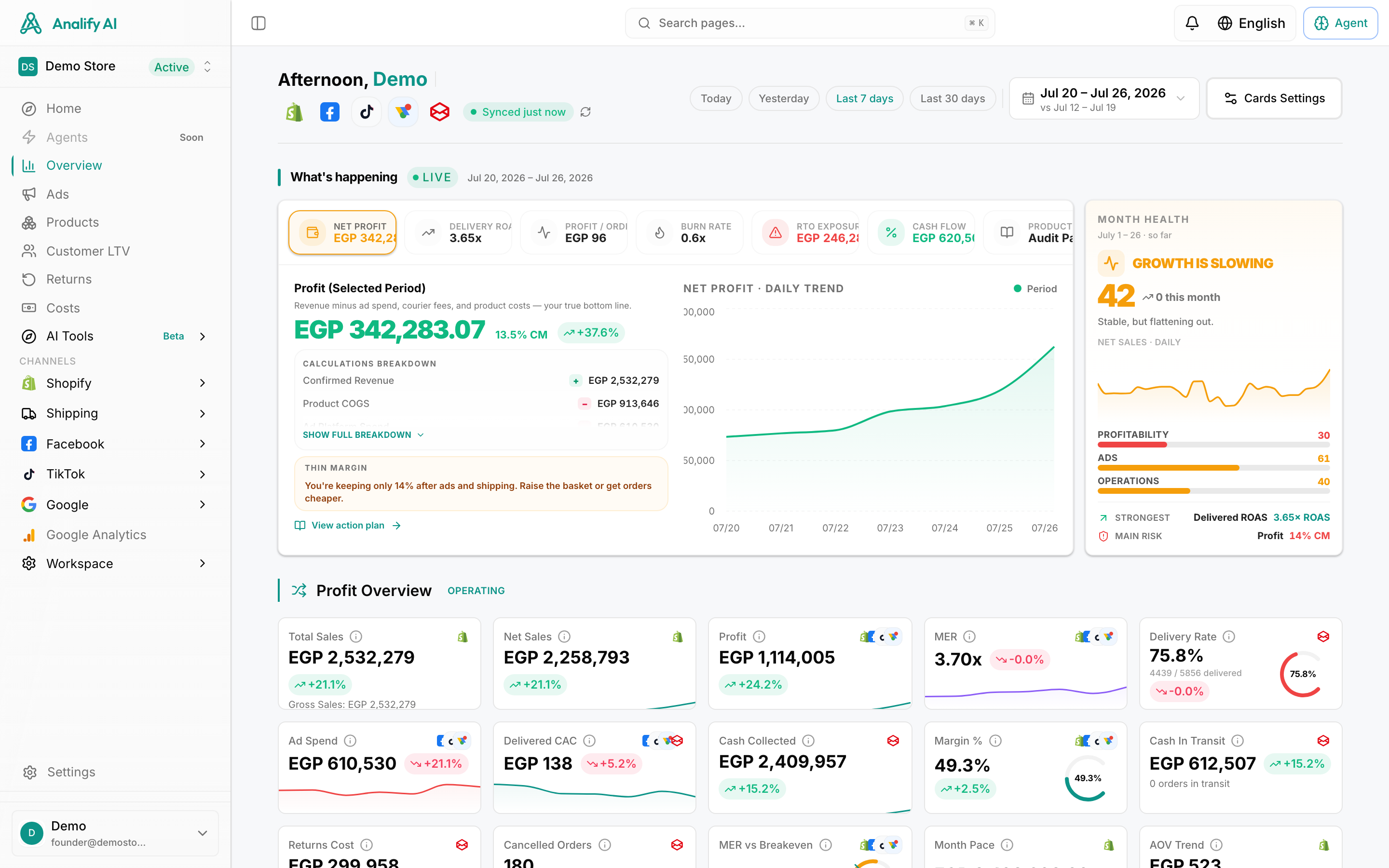
Platform Comparison: Top 15 Attribution Solutions
I've tested, implemented, and optimized campaigns using these analytics platforms. Here's the unfiltered breakdown:
1. Google Analytics 4 (Free)
Best for: Budget-conscious marketers with Google-heavy traffic
Google's data-driven attribution model is surprisingly sophisticated for a free tool. The machine learning algorithms analyze conversion paths and assign credit based on incremental impact. However, it's heavily biased toward Google channels and struggles with accurate Facebook attribution.
- Data-driven attribution with 30+ touchpoint analysis
- Cross-device tracking via Google signals
- Custom conversion paths and audience insights
- API access for data export
Integration Complexity: 2/5 (straightforward setup, complex customization)
Attribution Windows: 1-90 days (customizable)
Standout Feature: Conversion path analysis with detailed customer journey visualization
Limitations: Facebook attribution accuracy issues, limited non-Google channel insights, requires significant Google Ads spend for best results.
2. Triple Whale
Best for: E-commerce brands running multi-channel campaigns
Triple Whale positions itself as the "source of truth" for e-commerce attribution. Their pixel-based tracking combined with server-side data creates a comprehensive view of customer journeys. The platform excels at handling complex e-commerce scenarios like repeat purchases and long consideration cycles.
- Unified customer journey tracking across all channels
- Creative-level attribution for Facebook and Google ads
- Cohort analysis and customer lifetime value attribution
- Real-time attribution adjustments
Integration Complexity: 3/5 (requires technical setup but good documentation)
Attribution Windows: Fully customizable (1-365 days)
Standout Feature: Creative-level attribution that shows which specific ads drive conversions
Best Use Case: E-commerce brands spending $50K+ monthly across multiple channels
3. Analify
Best for: Meta advertising attribution and AI-powered optimization
Here's where things get interesting. Analify isn't just an attribution platform – it's an AI advertising platform that uses attribution data to automatically optimize your Meta campaigns. The AI Marketer feature continuously analyzes attribution patterns and adjusts budgets, audiences, and creative rotation based on what's actually driving conversions.
- AI-powered attribution modeling specifically for Meta campaigns
- Server-side tracking for iOS 14+ data recovery
- Creative-level attribution with automatic optimization
- Real-time budget allocation based on attribution insights
- 24/7 automated campaign monitoring and adjustment
Integration Complexity: 2/5 (streamlined setup with guided onboarding)
Attribution Windows: 1-28 days (optimized for Meta's attribution windows)
Standout Feature: AI automation that acts on attribution insights automatically
The game-changer here is the automation layer. While other ad platforms show you attribution data, Analify AI Marketer uses that data to automatically optimize your campaigns. It's like having a performance marketer working 24/7, making micro-adjustments based on real attribution insights.
Best Use Case: Performance marketers focused on Meta advertising who want attribution insights that automatically improve campaign performance.