Discover the 15 best ad tech platforms for e-commerce. Compare pricing, ROI data, and implementation complexity to choose the right advertising technology.
Picture this: You're scrolling through what feels like the hundredth "ad tech platform" article, and they all sound the same. Generic feature lists, no real pricing info, and zero guidance on what actually works for e-commerce stores like yours.
We get it – choosing the right advertising technology feels like navigating a maze blindfolded.
Here's the straight answer you're looking for: The global AdTech market reached $876.21 billion in 2024 and offers hundreds of platform options. But choosing the right ad tech platform for your e-commerce business comes down to three factors: your budget, technical complexity, and channel focus.
Unlike those other generic guides, we're breaking down 15 platforms with real implementation costs, complexity ratings, and actual ROI data from e-commerce campaigns. No fluff, no corporate speak – just the practical guidance you need to pick the ad tech platform that'll actually move the needle for your online store.
What You'll Learn
By the end of this guide, you'll have everything you need to make a confident decision:
- 15 top ad tech platforms ranked by e-commerce suitability with specific budget requirements
- Implementation complexity ratings (Easy/Moderate/Complex) for each platform
- Real ROI data and performance metrics from actual e-commerce campaigns
- Bonus: Decision framework to match your store size and technical resources to the right ad tech platform
What Are Ad Tech Platforms?
Let's cut through the industry jargon first. Ad tech platforms are software solutions that help you buy, manage, and optimize digital advertising across various channels. Think of them as your advertising command center – they connect your budget to the right audiences at the right time.
The advertising technology ecosystem includes two main types: Demand-Side Platforms (DSPs) that help you buy ad space, and Supply-Side Platforms (SSPs) that help publishers sell it. As an e-commerce business, you're primarily interested in DSPs and specialized advertising platforms that can drive traffic and sales to your online store.
Here's why this matters for your business: Programmatic advertising delivers up to 30% higher ROI compared to traditional manual ad buying methods. That's because these ad tech platforms use real-time data and automation to optimize your campaigns while you sleep.
For e-commerce specifically, you need ad tech platforms that understand the customer journey from awareness to purchase, can track revenue attribution accurately, and integrate seamlessly with your store's data. Generic advertising platforms often fall short because they're built for brand awareness, not direct-response sales.
Analify AI — free media buyer view
Stop guessing your profit.
Connect Shopify, Meta, TikTok and Bosta in 5 minutes.
Start free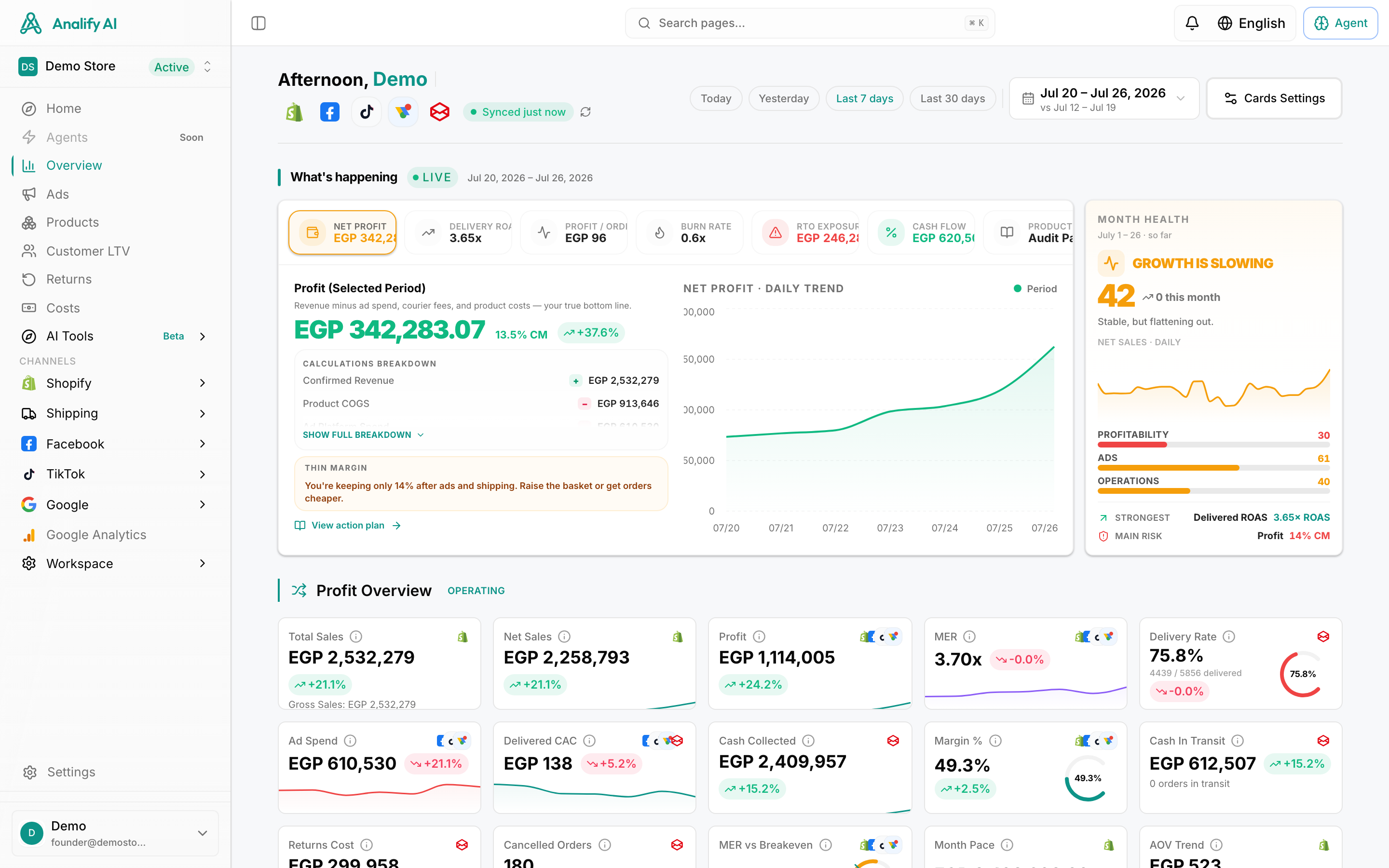
Types of Ad Tech Platforms for E-commerce
Not all ad tech platforms are created equal, especially when it comes to driving online sales. Here's how to think about the landscape:
Demand-Side Platforms (DSPs) are your heavy-duty programmatic buying tools. They connect to multiple ad exchanges and use sophisticated algorithms to bid on ad inventory in real-time. Perfect for scaling beyond social media once you've got your core channels dialed in.
Social Media Advertising Platforms like Facebook Ads Manager and TikTok Ads are where most e-commerce brands start and often generate their highest ROI. These ad tech platforms have built-in e-commerce features and massive user bases actively shopping.
Programmatic Advertising Solutions automate the ad buying process across display, video, and connected TV. They're ideal for retargeting website visitors and expanding your reach beyond social platforms with sophisticated audience targeting.
All-in-One Marketing Platforms combine advertising management with analytics, creative tools, and sometimes even email marketing. These can simplify your tech stack but may sacrifice depth for breadth.
Creative Management Platforms focus specifically on ad creative optimization, testing, and production. As creative becomes increasingly important for ad performance, these specialized tools are gaining traction among performance-focused e-commerce brands.
Pro Tip: The key is matching your business stage and resources to the right type of ad tech platform. Early-stage stores often succeed with social media platforms plus one creative tool, while scaling brands benefit from adding programmatic DSPs to their mix.
Top 15 Ad Tech Platforms for E-commerce
1. Analify - AI-Powered Meta Advertising Automation
Quick Take: AI-powered Meta ads optimization built for e-commerce brands who want to scale Facebook and Instagram advertising with reduced manual management.
Key Features: Analify AI Marketer performs daily account audits and provides one-click optimization recommendations, while the Creative Intelligence suite helps you identify winning ad elements. The Audience Launcher automates lookalike and interest targeting, and server-side tracking addresses iOS attribution challenges.
Pricing: Implementation: Easy (self-serve setup with guided onboarding) Minimum Budget: $1,000/month ad spend Designed for: Shopify stores, D2C brands, Facebook/Instagram focus ROI Data: Users typically report improved ROAS within 60 days
What sets Analify apart is its e-commerce-specific AI that understands purchase behavior, not just engagement metrics. The ad tech platform includes server-side tracking at no additional cost, addressing the iOS tracking challenges that affect most e-commerce advertisers.
2. Google Ads - Search Intent Capture Platform
Quick Take: The established ad tech platform for capturing high-intent shoppers actively searching for your products, with robust e-commerce integrations and Shopping campaigns.
Key Features: Shopping campaigns showcase your products directly in search results, while Smart Bidding uses machine learning to optimize for conversions. Performance Max campaigns automatically find customers across Google's entire ecosystem.
Pricing: No platform fees (pay per click/conversion) Implementation: Moderate (requires Google Merchant Center setup) Minimum Budget: $500/month for meaningful data Designed for: Product-focused e-commerce, high search volume categories ROI Data: Average $2 revenue for every $1 spent across e-commerce verticals
Google Ads excels at capturing bottom-funnel traffic when people are ready to buy. The learning curve is steeper than social platforms, but the intent quality is unmatched.
You'll also want to optimize your ad creative dimensions for maximum impact across Google's network.
3. Facebook Ads Manager - Social Commerce Platform
Quick Take: The native Meta advertising platform offering direct access to Facebook and Instagram's 3+ billion users, with built-in shopping features and detailed targeting options.
Key Features: Catalog ads automatically show relevant products to interested users, while dynamic retargeting brings back website visitors. The Conversions API helps maintain tracking accuracy post-iOS 14.5.
Pricing: No platform fees (pay per click/conversion) Implementation: Easy to start, moderate complexity to master Minimum Budget: $300/month for algorithm learning Designed for: Visual products, younger demographics, social proof-driven sales ROI Data: E-commerce advertisers typically average 4.2x ROAS on Facebook campaigns
Facebook Ads Manager offers powerful native features for e-commerce advertising. Many brands find success combining it with automation tools to handle optimization tasks while maintaining strategic control.
4. The Trade Desk - Enterprise Programmatic Platform
Quick Take: Enterprise-grade demand-side platform offering access to premium inventory across display, video, audio, and connected TV with sophisticated audience targeting.
Key Features: Unified ID 2.0 for cookieless targeting, cross-device tracking, and access to exclusive inventory. Advanced attribution modeling helps track the full customer journey.
Pricing: Typically 15-20% of media spend Implementation: Complex (requires dedicated team or agency) Minimum Budget: $10,000/month minimum Designed for: Large e-commerce brands, omnichannel campaigns ROI Data: Enterprise clients typically report 25-40% improvement in customer acquisition costs
The Trade Desk is designed for sophisticated advertisers who need enterprise-level programmatic capabilities and cross-channel attribution.
5. Amazon DSP - Retail Media Platform
Quick Take: Amazon's demand-side platform leveraging first-party shopping data to reach customers both on and off Amazon properties.
Key Features: Access to Amazon's shopping behavior data, programmatic buying across Amazon properties and external sites, and integration with Amazon's attribution system.
Pricing: Minimum $35,000 managed service or self-serve with $1,000 minimum Implementation: Moderate to complex Minimum Budget: $5,000/month for self-serve Designed for: Brands selling on Amazon, retail media strategies ROI Data: Advertisers typically see 3-5x higher conversion rates using Amazon's shopping data
Amazon DSP is valuable if you're selling on Amazon and want to leverage their customer data for broader advertising campaigns.
6. Criteo - Specialized Retargeting Platform
Quick Take: Specialized retargeting ad tech platform using machine learning to show personalized product ads to previous website visitors across the web.
Key Features: Dynamic product ads automatically show relevant items from your catalog, cross-device retargeting follows users across platforms, and predictive bidding optimizes for conversions.
Pricing: CPC or revenue share model Implementation: Moderate (requires pixel implementation) Minimum Budget: $2,000/month Designed for: Large product catalogs, international expansion ROI Data: Typically averages 7x ROAS for e-commerce retargeting campaigns
Criteo excels at bringing back website visitors who didn't purchase, making it a valuable addition to your retargeting strategy beyond social platforms.
Learn more about conversion tracking to measure success accurately across all your retargeting efforts.
7. StackAdapt - Native Advertising Platform
Quick Take: Native advertising platform that makes your ads look like editorial content, perfect for building brand awareness and reaching audiences in a non-intrusive way.
Key Features: Native ad formats that blend with content, advanced audience targeting, and real-time optimization. Strong performance on premium publisher sites.
Pricing: CPM-based with platform fees Implementation: Moderate Minimum Budget: $3,000/month Designed for: Content-driven e-commerce, brand building ROI Data: Native ads typically see 2-3x higher engagement than display
StackAdapt works well for e-commerce brands that can tell compelling stories about their products and want to reach audiences in a less aggressive way.
8. Adobe Advertising Cloud - Enterprise Integration Platform
Quick Take: Enterprise-level ad tech platform that integrates deeply with Adobe's marketing ecosystem, offering sophisticated cross-channel campaign management.
Key Features: Cross-channel campaign orchestration, advanced attribution modeling, and deep integration with Adobe Analytics and other Creative Cloud tools.
Pricing: Custom enterprise pricing Implementation: Complex (requires dedicated team) Minimum Budget: $50,000/month typically Designed for: Large enterprises with existing Adobe ecosystem ROI Data: Enterprise clients typically report 20-30% efficiency gains
9. Basis by Centro - Agency Management Platform
Quick Take: Comprehensive ad tech platform designed for agencies and large advertisers managing multiple clients and campaigns across various channels.
Key Features: Unified campaign management across channels, automated reporting, and workflow management tools. Strong focus on operational efficiency.
Pricing: Contact for custom pricing Implementation: Complex Minimum Budget: $10,000/month typically Designed for: Agencies, large advertisers with multiple brands ROI Data: Agencies typically report 40% time savings on campaign management
Basis excels at managing complexity but is designed for agencies and large-scale operations rather than individual e-commerce brands.
10. MediaMath - Data-Driven Campaign Platform
Quick Take: Data-focused DSP that emphasizes audience insights and predictive analytics to optimize campaign performance across channels.
Key Features: Advanced audience segmentation, predictive modeling, and cross-channel attribution. Strong focus on data science and optimization.
Pricing: Percentage of media spend Implementation: Complex Minimum Budget: $15,000/month Designed for: Data-rich e-commerce brands, sophisticated targeting needs ROI Data: Clients typically see 25-35% improvement in conversion rates
MediaMath is ideal for brands with rich customer data who want to leverage advanced analytics for targeting and optimization.
11. AdRoll - Small Business Retargeting Platform
Quick Take: User-friendly retargeting and prospecting ad tech platform designed specifically for small to medium-sized e-commerce businesses.
Key Features: Easy setup retargeting campaigns, email integration, and cross-channel advertising. Built-in creative tools and templates for quick campaign launch.
Pricing: Starting at $36/month plus ad spend Implementation: Easy Minimum Budget: $500/month Designed for: Small e-commerce stores, simple retargeting needs ROI Data: SMB clients typically average 5-8x ROAS on retargeting campaigns
AdRoll bridges the gap between DIY social media advertising and enterprise-level programmatic platforms, making it suitable for growing e-commerce brands.
12. Taboola - Content Discovery Platform
Quick Take: Native advertising platform that promotes content and products through "recommended for you" widgets on major publisher sites.
Key Features: Content-style ad formats, access to premium publisher inventory, and audience targeting based on content consumption behavior.
Pricing: CPC model with minimum spends Implementation: Moderate Minimum Budget: $1,000/month Designed for: Content marketing, brand awareness, lifestyle products ROI Data: E-commerce brands typically see 3-4x ROAS on content-driven campaigns
Taboola works well for e-commerce brands that can create compelling content around their products and want to reach audiences in discovery mode.
13. Outbrain - Content Marketing Platform
Quick Take: Content discovery platform that promotes articles, videos, and product content across premium publisher sites through native recommendation widgets.
Key Features: Native content promotion, premium publisher network, and sophisticated audience targeting based on content interests and behavior.
Pricing: CPC model Implementation: Moderate Minimum Budget: $1,000/month Designed for: Educational content, high-consideration products ROI Data: Content-driven e-commerce campaigns typically average 2-3x ROAS
Outbrain excels for e-commerce brands that invest in content marketing and want to amplify their reach beyond owned channels.
14. Snapchat Ads - Gen Z Targeting Platform
Quick Take: Mobile-first ad tech platform with strong Gen Z and millennial user base, offering unique AR ad formats and vertical video advertising.
Key Features: AR try-on ads for fashion and beauty, Snap Pixel for conversion tracking, and dynamic product ads for e-commerce catalogs.
Pricing: Auction-based with $5 daily minimums Implementation: Easy Minimum Budget: $300/month for learning Designed for: Fashion, beauty, lifestyle brands targeting younger demographics ROI Data: E-commerce brands typically report 4-6x ROAS with proper creative strategy
Snapchat's strength lies in its young, engaged user base and innovative ad formats that work particularly well for visual products.
15. TikTok Ads Manager - Video Commerce Platform
Quick Take: Rapidly growing video-first ad tech platform with highly engaged users and powerful algorithm for content discovery and shopping.
Key Features: Spark Ads that amplify organic content, Shopping Ads with direct checkout, and sophisticated interest and behavior targeting.
Pricing: Auction-based with $20 daily minimums Implementation: Easy to moderate Minimum Budget: $500/month for meaningful results Designed for: Video-friendly products, younger demographics, viral marketing ROI Data: E-commerce advertisers typically average 3-5x ROAS with strong creative
TikTok's algorithm is incredibly effective at finding interested audiences, but success heavily depends on creating native, entertaining content that doesn't feel like traditional advertising.
Ad Tech Platform Comparison Table
Advertising Platforms Comparison
Platform Designed For Starting Price Implementation Min Budget Primary Channel
Analify Meta Automation $45/mo Easy $1,000/month Facebook/Instagram
Google Ads Search Intent Free platform Moderate $500/month Search/Shopping
Facebook Ads Social Commerce Free platform Easy $300/month Social Media
The Trade Desk Enterprise Scale 15-20% of spend Complex $10,000/month Programmatic
Amazon DSP Retail Media $1,000 minimum Moderate $5,000/month Amazon Ecosystem
Criteo Retargeting Revenue share Moderate $2,000/month Display/Retargeting
StackAdapt Native Ads CPM-based Moderate $3,000/month Native/Display
Adobe Cloud Enterprise Custom pricing Complex $50,000/month Multi-channel
Basis Agency Management Custom pricing Complex $10,000/month Multi-channel
MediaMath Data-Driven % of spend Complex $15,000/month Programmatic
AdRoll SMB Retargeting $36/month Easy $500/month Cross-channel
Taboola Content Discovery CPC model Moderate $1,000/month Native/Content
Outbrain Content Marketing CPC model Moderate $1,000/month Native/Content
Snapchat Gen Z Targeting $5/day minimum Easy $300/month Mobile/Social
TikTok Video Commerce $20/day minimum Easy $500/month Video/Social
Analify AI — free media buyer view
Stop guessing your profit.
Connect Shopify, Meta, TikTok and Bosta in 5 minutes.
Start freeHow to Choose the Right Ad Tech Platform
Choosing the right ad tech platform isn't about finding the "best" one – it's about finding the best fit for your specific situation. Here's a practical framework to guide your decision:
Start with Budget AssessmentYour monthly ad spend determines which ad tech platforms are even accessible. If you're spending under $1,000/month, focus on social media platforms and simple automation tools. Between $1,000-$10,000/month opens up specialized platforms like Criteo and AdRoll. Above $10,000/month, enterprise DSPs become viable options.
Evaluate Your Technical ResourcesBe honest about your team's capabilities. Ad tech platforms like Facebook Ads Manager and Google Ads require significant learning curves. If you don't have dedicated advertising expertise, prioritize platforms with strong automation features or consider working with specialized ad tech platforms that reduce manual management.
Map Your Channel PrioritiesWhere do your customers spend time? B2C e-commerce brands often succeed on social platforms, while B2B companies might prioritize search and LinkedIn. Don't try to be everywhere at once – master one or two channels before expanding.
Consider Your Growth StageEarly-stage stores benefit from ad tech platforms with low minimums and easy setup. Scaling brands need sophisticated optimization and cross-channel attribution. Enterprise companies require platforms that can handle complexity and integrate with existing systems.
Pro Tip: The most successful e-commerce brands start simple and add complexity as they grow. Begin with one primary ad tech platform, master it, then strategically add complementary tools to your stack.
Integration Requirements Checklist:
✅ E-commerce platform integration (Shopify, WooCommerce, etc.)
✅ Analytics tools compatibility (Google Analytics)
✅ Email marketing system connections
✅ Customer data platform integration
✅ Attribution tracking capabilities
Poor integration leads to data silos and attribution headaches that can kill your ROI.
2025 Ad Tech Platform Trends for E-commerce
The ad tech platform landscape continues evolving rapidly, and staying ahead of these trends can give your e-commerce business a significant competitive advantage.
AI-Powered Creative Optimization is becoming table stakes. 80% of US ad buyers are using or exploring generative AI for creative development and optimization. Ad tech platforms that can automatically test and optimize creative elements will increasingly outperform manual approaches.
Connected TV Advertising Growth presents new opportunities for e-commerce brands. With streaming services gaining market share, CTV advertising is expected to grow 33% in 2025, offering premium inventory and sophisticated targeting options previously only available in digital channels.
First-Party Data Strategies are becoming critical as third-party cookies disappear. 54% of brands now rely exclusively on first-party data for targeting and personalization. E-commerce brands with strong customer data collection will have significant advantages.
Cookieless Advertising Preparation is no longer optional. The key is choosing ad tech platforms that are investing in advertising automation capabilities rather than clinging to legacy approaches that won't work in the evolving privacy landscape.
Pro Tip: The key is choosing ad tech platforms that are investing in these future-focused capabilities rather than clinging to legacy approaches that won't work in the evolving privacy landscape.
Frequently Asked Questions
What's the minimum budget needed for ad tech platforms?
Budget requirements vary significantly by ad tech platform. Social media platforms like Facebook and TikTok have no minimum spend requirements, making them accessible for any budget. However, you'll need at least $300-500/month to generate enough data for meaningful optimization.
Specialized ad tech platforms like Criteo require $2,000/month minimums, while enterprise DSPs like The Trade Desk typically need $10,000+/month. For most e-commerce stores, starting with $1,000/month across 1-2 platforms provides enough budget for effective testing and optimization.
Do I need a developer to implement ad tech platforms?
Implementation complexity varies dramatically. Social media platforms and tools like Analify offer self-serve setup that most business owners can handle in a few hours. Google Ads requires moderate technical knowledge for proper conversion tracking setup.
Enterprise ad tech platforms like Adobe Advertising Cloud or The Trade Desk typically require dedicated technical resources or agency support. If you're not technically inclined, prioritize platforms with guided setup processes and strong customer support.
Which ad tech platform has the best ROI for e-commerce?
ROI depends heavily on your product, audience, and execution quality rather than just the ad tech platform. However, social media platforms consistently deliver strong ROI for e-commerce due to their shopping-focused features and detailed targeting.
Google Ads averages $2 revenue for every $1 spent across e-commerce verticals. Specialized retargeting platforms like Criteo often deliver 7x+ ROAS. The key is matching your ad tech platform choice to your customer behavior and optimizing consistently rather than platform-hopping.
How long does it take to implement an ad tech platform?
Implementation timelines range from same-day setup to several months depending on complexity. Simple platforms like Facebook Ads or Snapchat can be running campaigns within hours. Google Ads typically takes 1-2 weeks to set up properly with conversion tracking.
Specialized ad tech platforms like Analify usually require 1-2 weeks for full integration and optimization setup. Enterprise DSPs can take 1-3 months for complete implementation including data integrations and team training. Plan accordingly and don't expect immediate results – most ad tech platforms need 2-4 weeks of data collection before optimization becomes effective.
What's the difference between ad tech platforms and marketing automation?
Ad tech platforms focus specifically on buying, managing, and optimizing paid advertising campaigns across various channels. Marketing automation platforms handle broader digital marketing activities like email sequences, lead nurturing, and customer journey orchestration.
Many modern platforms blur these lines – for example, some ad tech platforms now include email integration and customer lifecycle features. For e-commerce, you typically need both: ad tech platforms for customer acquisition and marketing automation for retention and lifecycle management.
Analify AI — free media buyer view
Stop guessing your profit.
Connect Shopify, Meta, TikTok and Bosta in 5 minutes.
Start freeChoose Your E-commerce Ad Tech Platform
The ad tech platform landscape offers incredible opportunities for e-commerce businesses willing to invest time in the right platforms. Based on our analysis, here are our top recommendations by business size:
For stores spending under $2,000/month: Start with Facebook Ads Manager or Google Ads, then add Analify for automation once you're ready to scale. This combination covers your primary acquisition channels while reducing manual management overhead.
For stores spending $2,000-$10,000/month: Combine social media advertising with specialized retargeting (Criteo or AdRoll) and consider adding programmatic display through StackAdapt for broader reach.
For stores spending $10,000+/month: Add enterprise DSPs like The Trade Desk for sophisticated cross-channel campaigns while maintaining strong performance on your core social and search channels.
Pro Tip: Remember, the most successful e-commerce brands master one ad platform before adding complexity. Start with your primary customer acquisition channel, optimize until you're consistently profitable, then strategically expand your ad tech stack.
Your next step is simple: identify where your customers spend time, choose the ad tech platform that serves that channel effectively, and commit to mastering it over the next 90 days. For Meta-focused e-commerce brands, Analify AI-powered optimization can significantly reduce the learning curve while improving performance from day one.
The future of e-commerce advertising belongs to brands that combine the right technology with consistent optimization and customer-focused creative. Choose your ad tech platform, start testing, and let the advertising data guide your decisions