Discover top AI systems that manage multi-platform ad buying automatically. We compare Analify, Albert.ai, and others to help you unify campaigns and scale.
Let's be honest, trying to manually manage ad campaigns in today's trillion-dollar advertising market feels a bit like trying to catch rain in a thimble. It's overwhelming, inefficient, and frankly, a recipe for burnout. We've all been there.
According to Improvado, programmatic advertising now accounts for approximately 90% of all digital display ad spending. If you're not using AI, you're not just falling behind—you're competing in a different sport entirely. And it can feel like you've been left on the sidelines.
But choosing the right AI platform can feel just as daunting. Do you need a simple rule-based assistant or a highly autonomous AI that handles complex optimizations? This guide is here to cut through the noise. We'll break down the top platforms, explain the tech that powers them (in plain English, we promise), and give you a clear framework for picking the right tool to save your sanity and scale your brand.
What is an AI Media Buying Platform?
Alright, let's start with the basics. At its core, an AI media buying platform uses technology to automate the process of buying ad space and optimizing campaigns. It's the brain behind the brawn of modern digital advertising, and a key part of any ad tech platform.
To really get it, we need to understand two key concepts.
First, programmatic advertising is the automated buying and selling of digital advertising space in real-time through an algorithmic process. Instead of manually negotiating ad placements with individual publishers (can you even imagine?), programmatic platforms do it all in the milliseconds it takes for a webpage to load. It's why you see ads for those sneakers you looked at yesterday follow you across the internet.
The engine that makes this possible for advertisers like us is the DSP. A Demand-Side Platform (DSP) is a system that allows buyers of digital advertising inventory to manage multiple ad exchange and data exchange accounts through one interface. Think of it as your central command center for buying ads across a vast network of websites, apps, and social platforms.
The real magic of these platforms is how they transform our roles. We stop being button-pushers, endlessly tweaking bids and budgets. Instead, we become strategists, guiding the AI, analyzing its insights, and focusing on the big-picture growth of our business. You get to work on your advertising, not just in it.
Rule-Based Automation vs. Autonomous AI: What's the Difference?
Not all AI is created equal. When you're looking at platforms, you'll generally find two flavors of automation: rule-based and autonomous. Understanding the difference is critical to picking the right tool for your needs—and avoiding a costly mismatch.
Rule-based automation is a system where an advertising platform automatically executes actions based on pre-set "if-this-then-that" conditions defined by a human user.
Think of it as your loyal, robotic bodyguard. You give it a set of strict instructions: "If the ROAS on this ad set drops below 2.5 for three consecutive days, pause it." The system executes your strategy tirelessly, 24/7. It's a massive time-saver, but it's still limited by the rules you create. This is the essence of automatic advertising.
Autonomous AI in advertising refers to systems that use machine learning to independently make and execute strategic decisions—such as budget allocation, bidding, and creative selection—without requiring pre-set rules from a user.
This is your Iron Man suit. You don't give it a list of rules; you give it a goal, like "maximize conversions within a $100,000 monthly budget." The AI then analyzes thousands of data points, learns from performance in real-time, and makes its own strategic decisions to achieve that goal.
Here's a simple breakdown:
Feature Rule-Based Automation Autonomous AI
Decision-Making Executes pre-set user commands ("If X, then Y") Makes its own strategic decisions based on a goal
Learning Does not learn; only follows instructions Learns and adapts continuously from performance data
User Input Requires detailed, ongoing rule creation Requires high-level goals and budget constraints
Best Use Case Executing a specific, proven strategy at scale Exploring new opportunities and optimizing complex, multi-channel campaigns
Analify AI — free ecommerce AI context
Stop guessing your profit.
Connect Shopify, Meta, TikTok and Bosta in 5 minutes.
Start free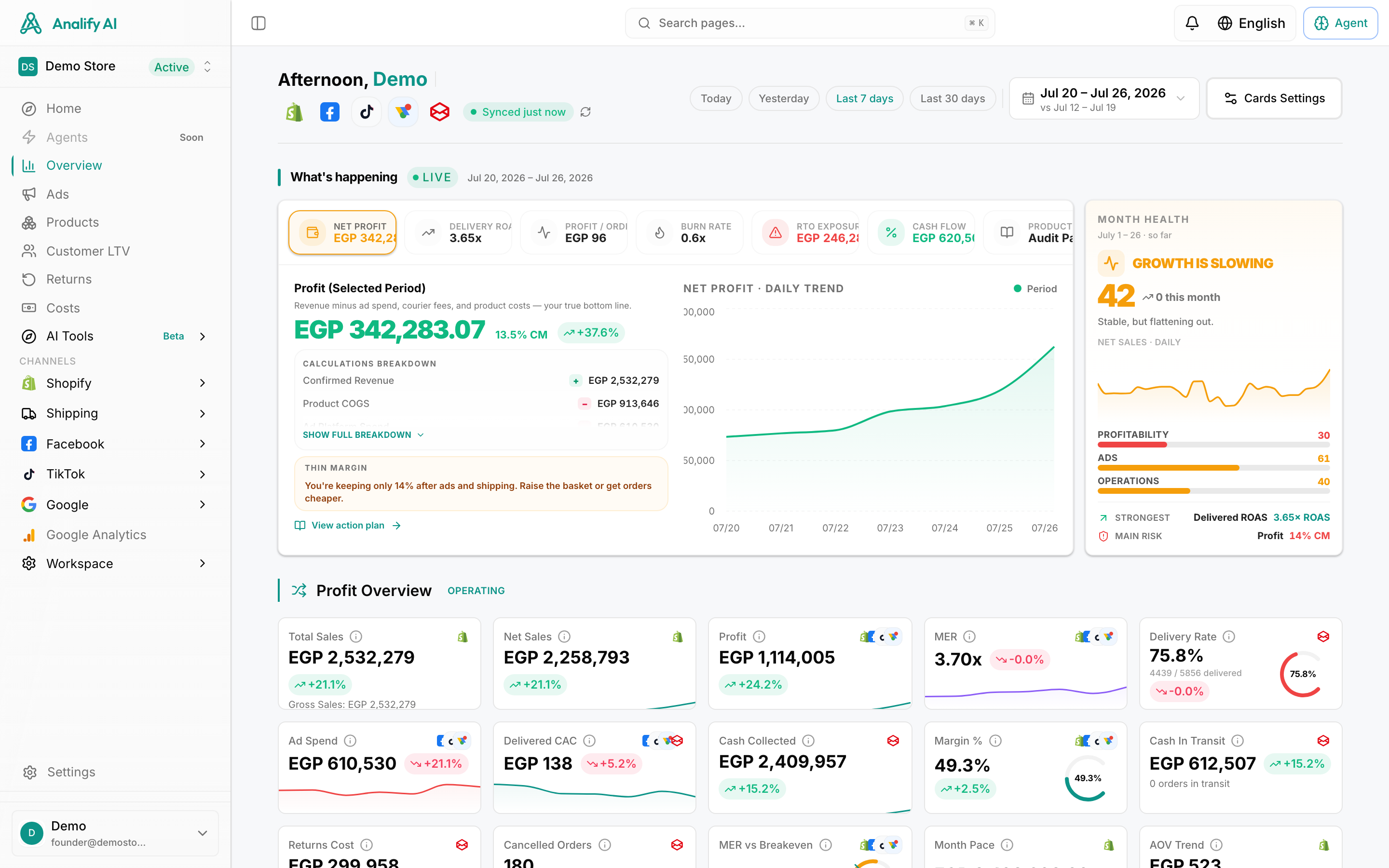
6 Leading AI Media Buying Platforms
So, which platform is right for you? We evaluated the top contenders based on what matters most to scaling brands: e-commerce focus, level of autonomy, multi-channel capabilities, and overall scalability.
Here's how they stack up.
Tool Specialty Key AI Feature Primary Channels Pricing Model
Analify E-commerce & Scaling Brands AI Creative + Optimization Meta, Google, TikTok Tiered Subscription
Albert.ai Enterprise-Level Autonomy Highly Autonomous Execution Search, Social, Programmatic % of Spend / Custom
Ryze AI Mid-Market Unification AI Analyst (Natural Language) Google, Meta Tiered Subscription
Smartly.io Enterprise Creative Automation Creative Automation at Scale Meta, TikTok, Pinterest % of Spend / Custom
The Trade Desk Programmatic Advertising at Scale Koa AI Bid Optimization Programmatic Display, CTV % of Spend
Optmyzr Google Ads Specialists One-Click Optimizations Google Ads Tiered Subscription
1. Analify (For E-commerce & Scaling Brands)
We might be a little biased, but we built Analify to solve a problem we faced ourselves. There's a massive gap between simple rule-based tools and hyper-expensive, highly autonomous platforms. Scaling e-commerce brands in the middle were left patching together a dozen different tools and drowning in spreadsheets.
Analify is designed to be the bridge. Our approach is built on three core pillars: