Master AI adoption roadmap with our 6-phase implementation guide for e-commerce. Strategic planning, seasonal timing, and proven frameworks for success.
Picture this: You're running a successful Shopify store, but you're spending 4+ hours daily on ad optimization, customer service, and inventory decisions. You know AI could help automate these tasks, but every "AI transformation guide" you find seems written for Fortune 500 companies with unlimited budgets and IT teams.
Here's the reality check: An AI adoption roadmap is a structured 6-phase framework guiding e-commerce businesses from strategic planning through full deployment. This systematic approach includes Strategic Assessment & Planning, Infrastructure & Data Preparation, Pilot Development & Testing, Deployment & Integration, Scaling & Optimization, and Governance & Continuous Improvement.
This framework addresses the 80% AI project failure rate by ensuring proper planning, seasonal timing, and realistic expectations for online retailers.
This guide breaks down each phase with e-commerce-specific timelines, budget considerations, and seasonal planning to help you implement AI without disrupting your revenue or customer experience. No corporate jargon, no impossible budgets – just practical steps that work for real e-commerce businesses.
What You'll Learn
By the end of this guide, you'll have:
- Phase-by-phase implementation timeline specifically designed for e-commerce seasonal cycles
- Budget planning framework with realistic cost expectations for different store sizes
- Risk mitigation strategies to protect revenue during AI implementation
- Bonus: Ready-to-use assessment checklist to determine your AI readiness score
Let's dive into the AI adoption roadmap that's helping e-commerce businesses successfully implement AI without the usual headaches.
Why 80% of AI Projects Fail (And How to Avoid It)
Here's something that might shock you: According to RAND Corporation research, 80% of AI projects fail to deliver expected results—twice the failure rate of traditional IT projects. E-commerce businesses face even steeper odds due to unique challenges like seasonal revenue cycles and customer experience dependencies.
The failure rate is getting worse, not better. MIT Sloan research shows that 42% of companies are now abandoning AI initiatives, compared to just 17% last year. But here's the thing – it's not because AI doesn't work. It's because most businesses skip the systematic approach.
Common E-commerce AI Mistakes:
- Peak Season Implementation – Launching AI during Q4 when you can't afford disruptions
- Data Chaos – Trying to implement AI with fragmented customer data across platforms
- All-or-Nothing Approach – Attempting to automate everything at once instead of starting small
- Ignoring Change Management – Not preparing your team for AI-enhanced workflows
The businesses that succeed? They follow a proven framework. They plan around seasonal cycles. They start with low-risk pilots and scale gradually. Most importantly, they understand that AI adoption is a marathon, not a sprint.
Pro Tip: Never launch AI implementations during your peak revenue periods. If you're in retail, avoid Q4 completely. If you're in fitness, skip January launches. Plan around your business cycles, not your excitement level.
Analify AI — free media buyer view
Stop guessing your profit.
Connect Shopify, Meta, TikTok and Bosta in 5 minutes.
Start free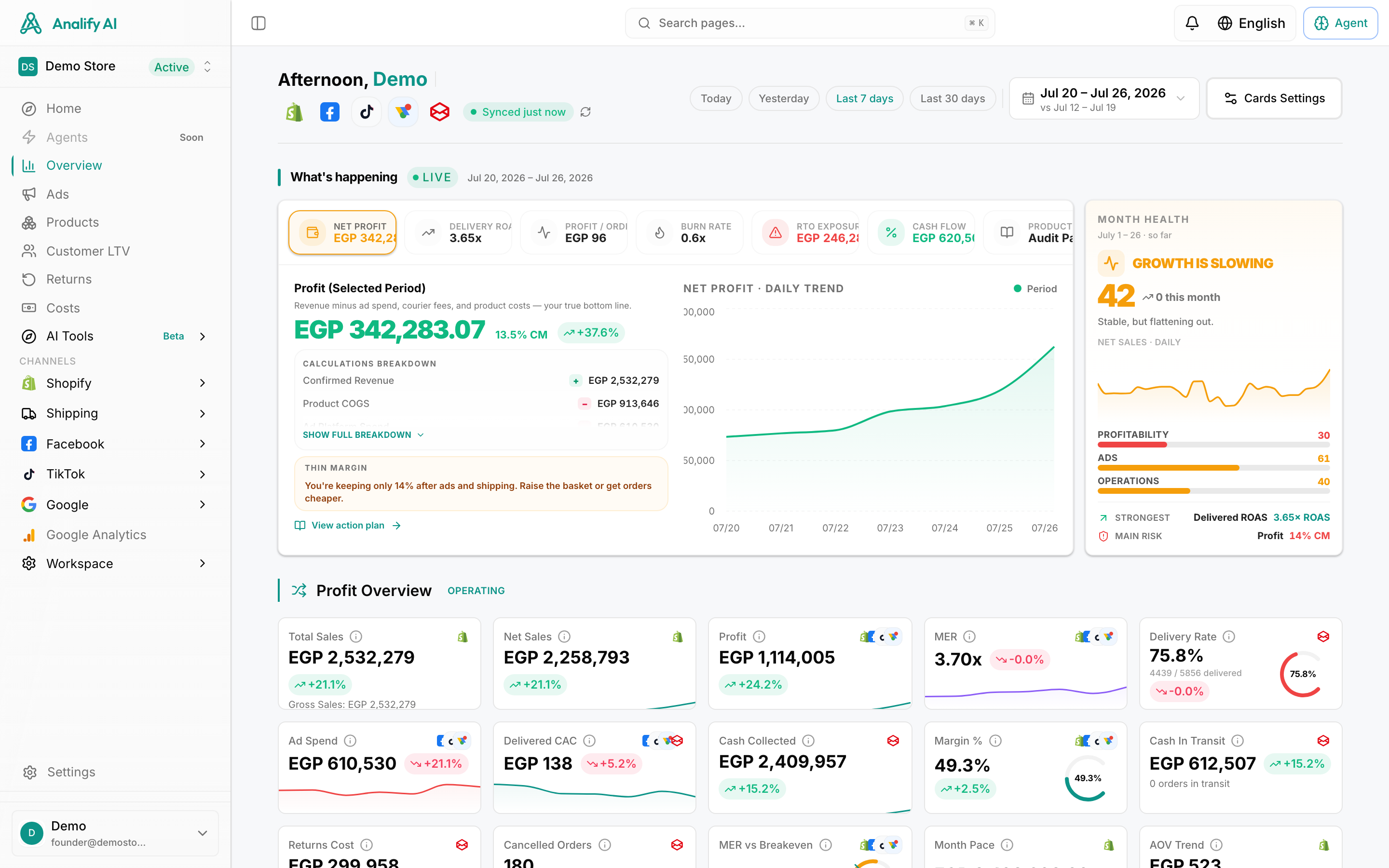
Phase 1: Strategic Assessment & Planning (Months 1-2)
Before you touch a single AI tool, you need to know where you stand. This phase is about honest assessment and realistic planning – think of it as your AI foundation.
E-commerce AI Readiness Assessment
Start with these critical questions:
- Do you have at least 12 months of clean customer data?
- Are your Facebook, Google, and email platforms properly connected?
- Can you track customer journeys from ad click to purchase?
Technical Infrastructure:
- Is your e-commerce platform (Shopify, WooCommerce) up-to-date?
- Do you have reliable analytics and reporting systems?
- Can your current hosting handle increased data processing?
- Who will champion the AI implementation?
- Does your team have basic data literacy?
- Are you prepared for workflow changes?
Seasonal Timing Strategy
Here's a pro tip that most guides miss: Never start AI implementation during your peak season. The timing of your AI rollout can make or break your success.
Ideal Implementation Calendar:
- January-February: Strategic planning and assessment
- March-May: Infrastructure and data preparation
- June-August: Pilot testing (perfect low-traffic period for most retailers)
- September-November: Gradual deployment before peak season
- December+: Monitor and optimize during high-traffic periods
This timeline protects your revenue during critical periods while giving you low-risk testing windows to perfect your AI systems.
Budget Framework: The 3-5% Rule
Plan to invest 3-5% of your annual revenue in AI implementation over 18 months. Here's how that breaks down:
For $1M Annual Revenue Store:
- Year 1: $30,000-50,000 total investment
- Tools & Platforms: $15,000-25,000
- Training & Consulting: $10,000-15,000
- Infrastructure Upgrades: $5,000-10,000
For $5M Annual Revenue Store:
- Year 1: $150,000-250,000 total investment
- Advanced AI Platforms: $75,000-125,000
- Dedicated AI Specialist: $50,000-75,000
- Custom Integrations: $25,000-50,000
Remember, this isn't just an expense – it's an investment. Successful AI implementations typically show 15-30% improvement in key metrics within the first year.
Phase 2: Infrastructure & Data Preparation (Months 3-5)
This is where most e-commerce businesses want to rush, but trust me – solid foundations prevent expensive mistakes later. Think of this phase as organizing your digital house before the AI renovation.
Customer Data Integration
Your AI is only as good as your data. Here's your integration checklist:
Primary Data Sources:
- E-commerce Platform: Customer profiles, purchase history, product interactions
- Advertising Platforms: Facebook, Google, TikTok campaign data and audience insights
- Email Marketing: Klaviyo, Mailchimp engagement and conversion data
- Customer Service: Support tickets, chat logs, satisfaction scores
Data Quality Standards:
- Remove duplicate customer records (aim for 95%+ accuracy)
- Standardize naming conventions across platforms
- Implement proper UTM tracking for all campaigns
- Set up conversion tracking that actually works
Platform Preparation
Shopify Store Optimization:
- Update to the latest theme version
- Install necessary tracking pixels (Facebook, Google, TikTok)
- Implement enhanced e-commerce tracking for better data collection
- Set up proper product categorization for AI recommendations
Marketing Platform Consolidation:
- Centralize campaign management where possible
- Implement consistent naming conventions
- Set up automated reporting dashboards
- Create backup systems for critical data
Privacy Compliance Setup
With iOS updates and privacy regulations, this step is non-negotiable:
- GDPR/CCPA Compliance: Update privacy policies and consent mechanisms
- First-Party Data Strategy: Reduce dependence on third-party cookies
- Server-Side Tracking: Consider solutions like the platform for improved data accuracy
- Customer Communication: Prepare transparency messaging about AI usage
The key here is building trust through transparency while maintaining compliance with evolving privacy standards.
Phase 3: Pilot Development & Testing (Months 6-8)
Now comes the fun part – your first AI implementation. But we're starting small and smart, not big and risky.
Selecting Your First Pilot Project
Best Starting Points for E-commerce:
- Ad Optimization (Lowest Risk, Highest Impact)
- AI-assisted bid adjustments
- Budget optimization and reallocation recommendations between campaigns
- Audience optimization based on performance
- Creative Testing (Medium Risk, High Learning)
- AI-generated ad variations
- AI-assisted creative rotation with human oversight
- Performance-based creative optimization recommendations
- Customer Service (Low Risk, Immediate ROI)
- Chatbot for common questions
- Automated order status updates
- Basic product recommendations