Learn how to use ad personalization to boost e-commerce sales. Complete 2025 guide with AI strategies, cookieless tactics, and step-by-step setup.
Picture this: Two identical Shopify stores launch the same product on the same day. Store A blasts generic ads to everyone who might be interested. Store B uses AI to personalize every single ad based on browsing behavior, purchase history, and behavioral intent indicators.
After 30 days, Store B generates 3X more revenue with the exact same ad spend. Sound too good to be true?
Here's the thing – ad personalization is the practice of using customer data and AI technology to deliver customized advertising experiences that match individual preferences, behaviors, and purchase intent in real-time. And it's not just working; it's becoming absolutely essential for e-commerce survival in 2025.
With iOS changes crushing traditional targeting and third-party cookies disappearing faster than free samples at Costco, the businesses that master AI-powered personalization are the ones that'll thrive. Meanwhile, their competitors wonder what happened to their ROAS.
In this complete guide, you'll discover exactly how to implement ad personalization that actually drives results for your e-commerce business – no PhD in data science required.
What You'll Learn
- How to implement AI-powered personalization that can increase ROI
- 5 cookieless personalization strategies that work in 2025's privacy-first landscape
- Step-by-step setup process for AI-assisted cross-platform personalization
- Bonus: Ready-to-use personalization templates for different e-commerce verticals
What Is Ad Personalization? (The Complete Definition)
Let's get crystal clear on what we're talking about here. Ad personalization is the strategic use of customer data, behavioral insights, and AI technology to create and deliver customized advertising experiences that align with individual user preferences, shopping behaviors, and purchase intent in real-time.
Think of it as having a personal shopping assistant for every single person who sees your ads. Except this assistant knows exactly what they've been browsing, what they've bought before, and what they're most likely to purchase next.
Why Ad Personalization Matters More Than Ever in 2025
Three words: privacy, competition, and expectations.
First, Apple's iOS changes and Google's cookie deprecation have made traditional "spray and pray" advertising about as effective as a chocolate teapot. We can't rely on third-party data anymore, so we need to get smarter about using the first-party data we do have access to.
Second, your competitors are already doing this. According to Epsilon research, 80% of consumers are more likely to make a purchase when brands offer personalized experiences. If you're not personalizing, you're basically showing up to a knife fight with a spoon.
Pro Tip: Start collecting first-party data immediately if you haven't already. Set up email capture, post-purchase surveys, and website behavior tracking. This data goldmine will fuel your personalization efforts and keep you ahead of the privacy curve.
Analify AI — free media buyer view
Stop guessing your profit.
Connect Shopify, Meta, TikTok and Bosta in 5 minutes.
Start free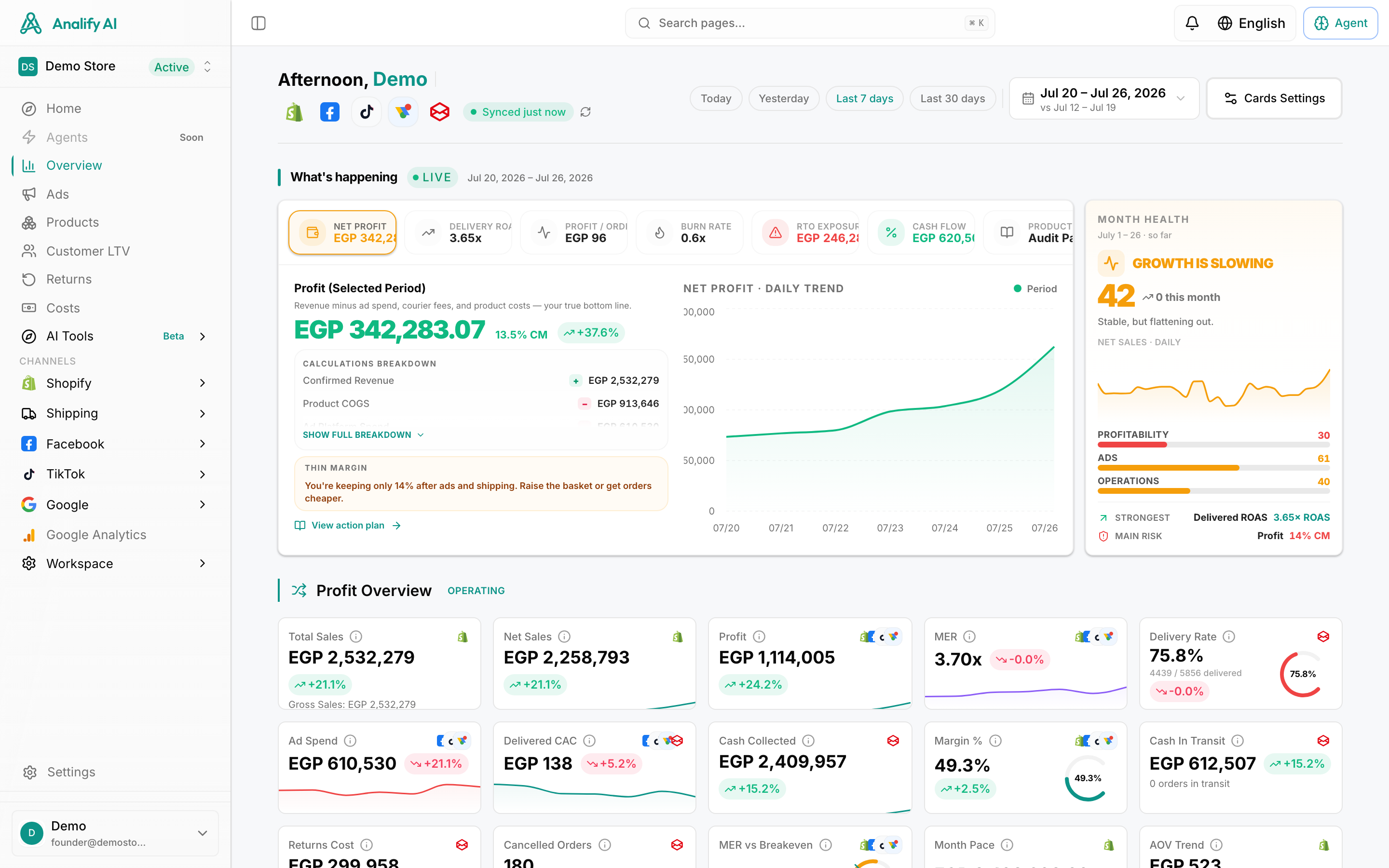
The ROI Impact: Why E-commerce Businesses Can't Ignore Ad Personalization
Here's where things get really interesting. We're not talking about marginal improvements here – we're talking about game-changing results that can literally transform your business.
McKinsey research shows that companies implementing advanced personalization see revenue increases of 20–30% and marketing spend efficiency improvements of 10-20%. But for e-commerce businesses specifically, the numbers are even more impressive.
The Real Numbers That Matter
When you implement proper ad personalization, you're looking at:
- Up to 3X higher ROI compared to generic advertising campaigns
- 92% of marketers report improved conversion rates when they implement personalization strategies, according to Evergage's State of Personalization Report
- Personalized retargeting campaigns can boost engagement by up to 400% compared to standard retargeting
But here's what really gets me excited: instead of showing someone the exact same product they already looked at, you're showing them complementary products, size variations, or addressing specific objections based on their behavior.
The Cost of NOT Personalizing
You're essentially burning money. Generic ads in 2025 are like trying to sell snow to Eskimos – even if you have a great product, you're not speaking their language.
Real talk: I've seen e-commerce stores go from struggling to hit 2X ROAS to achieving 6X+ ROAS in many cases just by implementing smart personalization. The difference isn't the product or the market – it's showing the right message to the right person at the right time.
5 Types of Ad Personalization That Drive E-commerce Sales
Now let's get into the meat and potatoes. There are five core types of personalization that actually move the needle for e-commerce businesses. Master these, and you'll be ahead of 90% of your competition.
1. Behavioral Targeting (The Purchase Prophet)
This is where you become a mind reader. Behavioral targeting uses past purchases, browsing patterns, and on-site behavior to predict what someone wants next.
For example, if someone bought running shoes from you three months ago, you might show them ads for running socks, fitness trackers, or seasonal running gear. If they've been browsing your winter coat section but haven't purchased, you could show them reviews, size guides, or limited-time offers.
The magic happens when you layer behaviors. Someone who bought a coffee maker AND browsed your kitchen accessories section is prime for coffee-related upsells. This is where AI targeting for ads becomes incredibly powerful – it can spot patterns humans would miss.
2. Demographic Personalization (Know Your Audience)
This isn't just about age and location anymore. Modern demographic personalization includes lifestyle indicators, income brackets, family status, and interests that actually matter for purchase decisions.
A 25-year-old single professional in Manhattan needs different messaging than a 35-year-old parent in suburban Ohio, even if they're buying the same product. The single professional might care about convenience and style, while the parent focuses on value and durability.
Smart e-commerce brands create different ad creative and copy for different demographic segments, then let AI optimize which version performs best for each micro-audience.
3. Contextual Advertising (Right Place, Right Time)
With cookies crumbling, contextual advertising is making a massive comeback. This means showing ads based on the content someone is currently viewing, the time of day, weather, or current events.
Selling fitness equipment? Your ads perform differently on Monday morning (motivation is high) versus Friday evening (people are thinking about weekend plans). Selling winter coats? Target people checking weather apps when temperatures drop.
The beauty of contextual advertising is that it doesn't rely on personal data – it's based on the immediate context and environment.
4. Predictive Personalization (The Crystal Ball)
This is where AI really shines. Predictive personalization uses machine learning to forecast what someone is likely to buy next, when they're likely to buy it, and how much they're willing to spend.
For instance, if your AI notices that customers who buy Product A typically purchase Product B within 30 days, you can proactively show Product B ads to recent Product A buyers. Or if someone's purchase frequency suggests they're due for a reorder, you can hit them with a perfectly timed replenishment campaign.
Audience targeting AI takes this even further by identifying lookalike patterns and finding new customers who match your best buyers' behavioral signatures.
5. Cross-Device Personalization (The Seamless Journey)
Your customers don't live on just one device. They browse on mobile during lunch, research on desktop at work, and buy on tablet while watching TV. Cross-device personalization ensures your messaging stays consistent and relevant across all touchpoints.
This means if someone adds items to cart on mobile but doesn't complete the purchase, you can show them a simplified checkout ad when they're on desktop. Or if they've been researching a high-ticket item across multiple sessions, you can provide social proof and reviews to push them over the finish line.
The key is creating a unified customer profile that tracks behavior across devices and platforms, then using that data to deliver the right message at the right moment, regardless of where they are.
How to Set Up AI-Powered Ad Personalization (Step-by-Step)
Alright, enough theory. Let's get your hands dirty with the actual implementation. I'm going to walk you through the exact process I use to set up personalization systems that actually work.
Step 1: Audit Your Current Data Collection
Before you can personalize anything, you need to know what data you're working with. Most e-commerce businesses are sitting on a goldmine of customer information but don't realize it.
- Website analytics (Google Analytics 4, heatmaps, session recordings)
- Customer purchase history and frequency
- Email engagement data
- Social media interactions
- Customer service interactions
- Product reviews and ratings
- Export your customer data from your e-commerce platform
- Check your Facebook Pixel and Google Analytics setup
- Review your email marketing platform data
- Identify data gaps where you need better collection Pro Tip: If you're using Shopify, you're already collecting tons of valuable data. The trick is connecting it to your advertising platforms effectively.
Step 2: Choose Your Personalization Platform
Here's where most people get overwhelmed by options. The truth is, you need a platform that can actually handle e-commerce complexity without requiring a team of data scientists.
- Native e-commerce integrations (Shopify, WooCommerce, etc.)
- Cross-platform campaign management (Meta, Google, TikTok)
- AI-powered optimization recommendations
- Real-time data processing capabilities
This is where Analify really shines for e-commerce businesses. The platform seamlessly integrates your Shopify reporting data with your advertising accounts, then uses AI to create and optimize personalized campaigns across all major platforms. No manual data exports or complex integrations required.