Discover the top 6 AI Facebook ads reporting tools. Compare platforms like Analify and Triple Whale to solve attribution issues and get truly accurate performance data.
If you've ever stared at your Facebook Ads Manager dashboard, squinted at the numbers, and thought, "Can I really trust this?"—you're not alone. We get it.
We're all navigating a crazy-complex data environment. Between iOS updates making attribution a total guessing game and Meta's own platform feeling like a hall of mirrors, getting a straight answer on performance is harder than ever. And with Meta's ad revenue projected to reach $200 billion by 2026, the stakes are only getting higher.
But here's the good news: a new breed of AI-powered reporting tools is here to cut through the noise. And with major Meta API changes looming in January 2026, choosing the right one isn't just a good idea—it's essential for protecting your ad spend.
This guide will give you a clear, no-fluff comparison of the leading tools so you can get insights you can actually act on.
Why Relying on Meta Ads Manager Alone Presents Challenges in 2026
We all use Facebook Ads Manager—it's the command center for Meta advertising. But let's be honest, in today's complex ecosystem, relying on it solely can feel like navigating a freeway with an outdated map.
It just doesn't give you the full picture anymore. Here's a breakdown of why:
- The Post-iOS 14 Attribution Mess: Ever since Apple's privacy updates, the Meta pixel has been on shaky ground. Data gets delayed, conversions are missed, and you end up optimizing your campaigns based on incomplete signals.
- The Data Silo Problem: Your customers don't just live on Facebook and Instagram. They see your Google Ads, click your TikToks, and open your Klaviyo emails. Ads Manager doesn't show you that cross-channel journey, giving you a one-dimensional view in a multi-dimensional world.
- It's Reactive, Not Proactive: Ads Manager is great at telling you what happened yesterday. It's not so great at explaining why something is happening right now or what might happen tomorrow. With costs climbing, we need tools that can spot trouble before it drains our budget.
The bottom line is that for serious advertisers, relying only on Meta Ads Manager is a risky game. We need a more comprehensive source of truth, and that means looking beyond the native platform.
What Are AI-Powered Reporting Tools? (And How They Work)
"AI" is a term that gets thrown around so much it's almost lost its meaning. So, let's cut through the buzzwords and talk about what it actually means for reporting, as there are many different AI tools for advertising out there.
AI-powered reporting is the use of artificial intelligence to not only aggregate and visualize marketing data but also to perform automated diagnostics, predict future performance trends, and provide prescriptive recommendations for optimization.
Think of it this way:
- A standard dashboard (like Ads Manager) shows you the what (your CPA was $50).
- An AI-powered reporting tool shows you the why (your CPA was $50 because your primary audience is fatigued) and the what's next (you should probably pause this ad set and reallocate the budget to this other one).
These tools work by layering different types of AI on top of your data:
- Diagnostic AI: This is like having a 24/7 account analyst. It sifts through thousands of data points to find hidden patterns, like an ad set that's secretly draining your budget or a winning audience you completely overlooked.
- Predictive AI: This is your crystal ball. In advertising, predictive modeling is a statistical technique that uses machine learning and historical data to forecast future outcomes, such as campaign ROAS, customer lifetime value, or creative fatigue. It helps you answer questions like, "Is this campaign going to burn out next week?" and is a core component of predictive Meta ad optimization.
So how do these platforms get the high-quality data needed for this magic?
Enter server-side tracking. This is the key. Server-side tracking, like Meta's Conversions API (CAPI), is a method of sending customer event data directly from a company's server to Meta's server, bypassing browser-based tracking limitations like ad blockers and iOS restrictions.
This creates a much more reliable and stable data pipeline—the solid foundation you need for any meaningful AI analysis.
Pro Tip: True AI in advertising isn't just about simple automation. Simple automation follows pre-set rules ("if spend > $100 and ROAS < 2, then pause ad"). Machine learning, the engine behind true AI, learns from your unique account data over time to make smarter, more nuanced recommendations that a simple rule could never replicate.
Analify AI — free Meta profit view
Stop guessing your profit.
Connect Shopify, Meta, TikTok and Bosta in 5 minutes.
Start free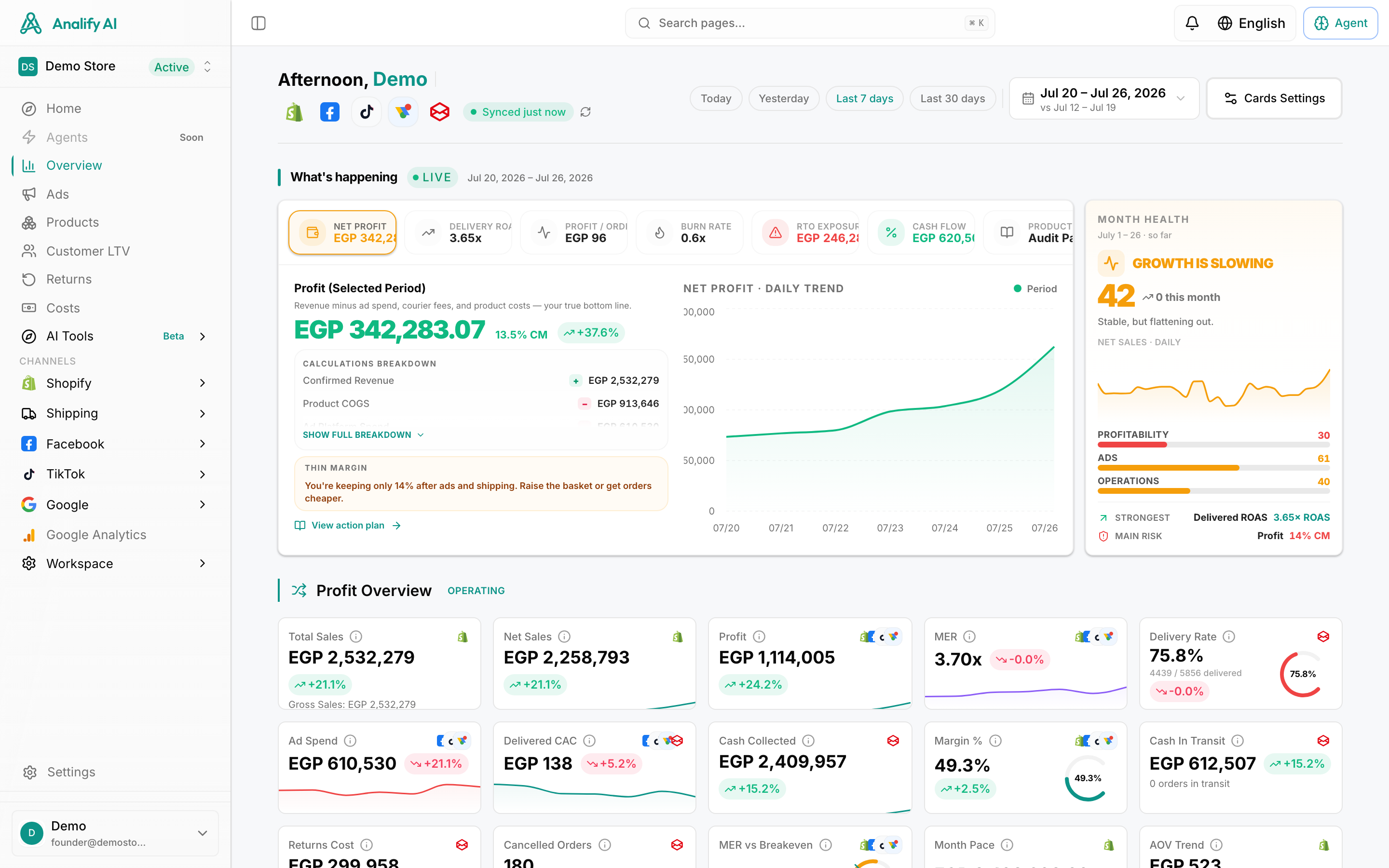
How to Choose a Facebook Ads Reporting Tool: 5 Key Criteria
Okay, you're convinced you need a better tool. But with so many options, how do you choose the right one for your business? It's not about finding the single "best" tool, but the best Facebook ads reporting tool for you.
Here are five key criteria to help you evaluate any platform.
1. Attribution Model & Accuracy
This is the absolute foundation. The quality of your data determines the quality of your insights.
- What to ask: Does it use server-side tracking (CAPI) to get around pixel issues? Does it offer its own attribution model to give you a "second opinion" outside of Meta's often-inflated numbers?
2. AI-Driven Insights
A pretty dashboard is nice, but insights are what move the needle. You want a tool that thinks for you, not just one that displays data.
- What to ask: Does it offer predictive analytics (like forecasting creative fatigue) and diagnostics (like finding hidden budget-wasters)? Or is it just a fancy data visualizer? Pro Tip: A great test for a tool's AI is to see if it has a feature like Analify AI Chat . Can you ask it questions about your performance? This shows the AI is built for practical analysis, not just data display.
3. Multi-Channel Integration
Your business doesn't run on Facebook alone, so your Facebook ads reporting tool shouldn't either. A holistic view is non-negotiable.
- What to ask: Can it pull in data from all your key channels—Meta, Google Ads, TikTok, GA4, and your e-commerce platform (like Shopify) or email provider (like Klaviyo)—into a single, unified dashboard?
4. Creative Intelligence
We've all heard it a million times: creative is the new targeting. With broad audiences becoming the norm, your ad creative is one of the biggest levers you can pull. According to Motion, creative accounts for 70% of an ad's overall performance.
- What to ask: Can the tool actually analyze your ad creatives? Creative intelligence is a marketing analytics discipline that uses AI to analyze visual and textual elements within ad creatives (images, videos, copy) and correlate them directly with performance metrics like ROAS or CPA**.** It should help you understand why certain ads are crushing it and others are flopping.
5. Ease of Use & Setup
The most powerful tool in the world is useless if it's too complicated to set up or requires a data science degree to operate.
- What to ask: How painful is the setup process? Is the interface intuitive? Can you get answers in a few clicks, or do you have to build complex reports from scratch every time?
6 Top AI Facebook Ads Reporting Tools for 2026
We analyzed dozens of tools based on the criteria above. Here are six that stand out as leading solutions for navigating the wild world of Facebook advertising in 2026.
1. Analify
- Ideal for: E-commerce Brands & Agencies Needing Multi-Channel Reporting & AI Optimization.
- Pricing: The Analify Pro Complete plan
We built Analify to be the platform we always wished we had as media buyers. It's a comprehensive tool that combines a multi-channel view with deep AI diagnostics and optimization capabilities.