Learn how to scale your agency with a proven business social media marketing framework. Master client goal-setting, ROI attribution, and reporting.
It’s Monday morning. You’re staring at a screen filled with 15 different client tabs, each one a universe of its own.
Client A needs a performance report for last week’s Meta campaign, Client B wants to know why their TikTok engagement dipped, and Client C just sent a Slack message that says, "We need more fresh ideas!" The multi-platform chaos is real, and your team is stretched thinner than a shoestring budget. Sound familiar?
We’ve all been there. For marketing agencies, social media management is often the service line that promises recurring revenue but delivers operational headaches. It’s a classic bottleneck. What works for one client doesn’t work for another, reporting is a soul-crushing time-suck, and scaling feels less like a strategy and more like a pipe dream.
But here’s the thing: it doesn’t have to be this way. The secret isn’t working harder; it’s working smarter with a repeatable system.
So, what are we really talking about here? At its core, business social media marketing is the strategic use of platforms like Facebook, Instagram, LinkedIn, and TikTok to promote products/services, engage customers, and drive business growth. For us as agencies, it's about creating a repeatable system that delivers measurable results like brand awareness, lead generation, and sales across a diverse client portfolio.
This playbook isn’t just another list of tips. It’s the blueprint we're going to build together for an efficient, scalable, and profitable social media service line for your agency.
What You'll Learn
- How to build a 7-step scalable social media system you can apply to any client.
- How to use data to prove social media ROI and build client trust.
- How to select the right tech stack to improve agency efficiency and profitability.
Why Social Media Is a Goldmine for Your Clients (6 Data-Backed Benefits)
Before we can build a scalable system, we need client buy-in. And let's be honest, nothing builds buy-in like cold, hard data.
The next time a prospective client asks, "But is social media really worth it?" you’ll have the perfect answer ready to go.
Pro Tip: Use these stats in your next client proposal to frame your services as a strategic investment, not a cost center.
1. Unprecedented Business Exposure
The simplest benefit is often the most powerful. Being on social media puts a brand in front of people. Period. It’s digital real estate in the busiest neighborhood on the planet.
According to a Sprout Social survey, a staggering 90% of marketers say social media has increased exposure for their business. It’s the modern-day town square, and if your clients aren’t there, they’re practically invisible.
2. A Direct Impact on Sales
Social media isn't just for brand awareness anymore; it's a full-fledged sales channel. From shoppable posts on Instagram to the "TikTok made me buy it" trend, these platforms are closing the gap between discovery and purchase.
In fact, social networks are projected to generate 17.11% of total online sales by 2025, making them a critical revenue stream for e-commerce and service-based businesses alike.
3. Higher Customer Lifetime Value (LTV)
A customer who feels connected to a brand is a customer who sticks around and spends more. Social media is the ultimate tool for building those relationships and transforming one-time buyers into a loyal community.
Research from Bain & Company shows that customers who engage with companies over social media are more loyal and spend 20% to 40% more money with those companies than other customers. For your clients, that means higher LTV and more predictable revenue.
4. Strong Return on Investment (ROI)
When it comes to advertising, every dollar counts. We need to show clients that their investment is paying off. The good news? Social media advertising can deliver some seriously impressive returns.
While results vary, the average return on investment for social media ads is around 250%. This powerful ROI is why understanding AI in marketing is no longer optional; it's essential for maximizing every dollar spent.
5. Access to a Massive, Engaged Audience
The scale of social media is almost impossible to comprehend. We're not talking about millions of users; we're talking about billions.
Projections show that the number of global social media users will reach 5.24 billion in 2025, representing the majority of the world's population. No other channel offers this level of access to potential customers.
6. Powerful Paid Amplification
Organic reach is great, but paid social is how you pour gasoline on the fire. It allows you to target your ideal customer with surgical precision, ensuring your message reaches the people most likely to convert.
With global social ad spend expected to hit $276.7 billion in 2025, it's clear that businesses are betting big on paid amplification to drive growth.
Analify AI — free media buyer view
Stop guessing your profit.
Connect Shopify, Meta, TikTok and Bosta in 5 minutes.
Start free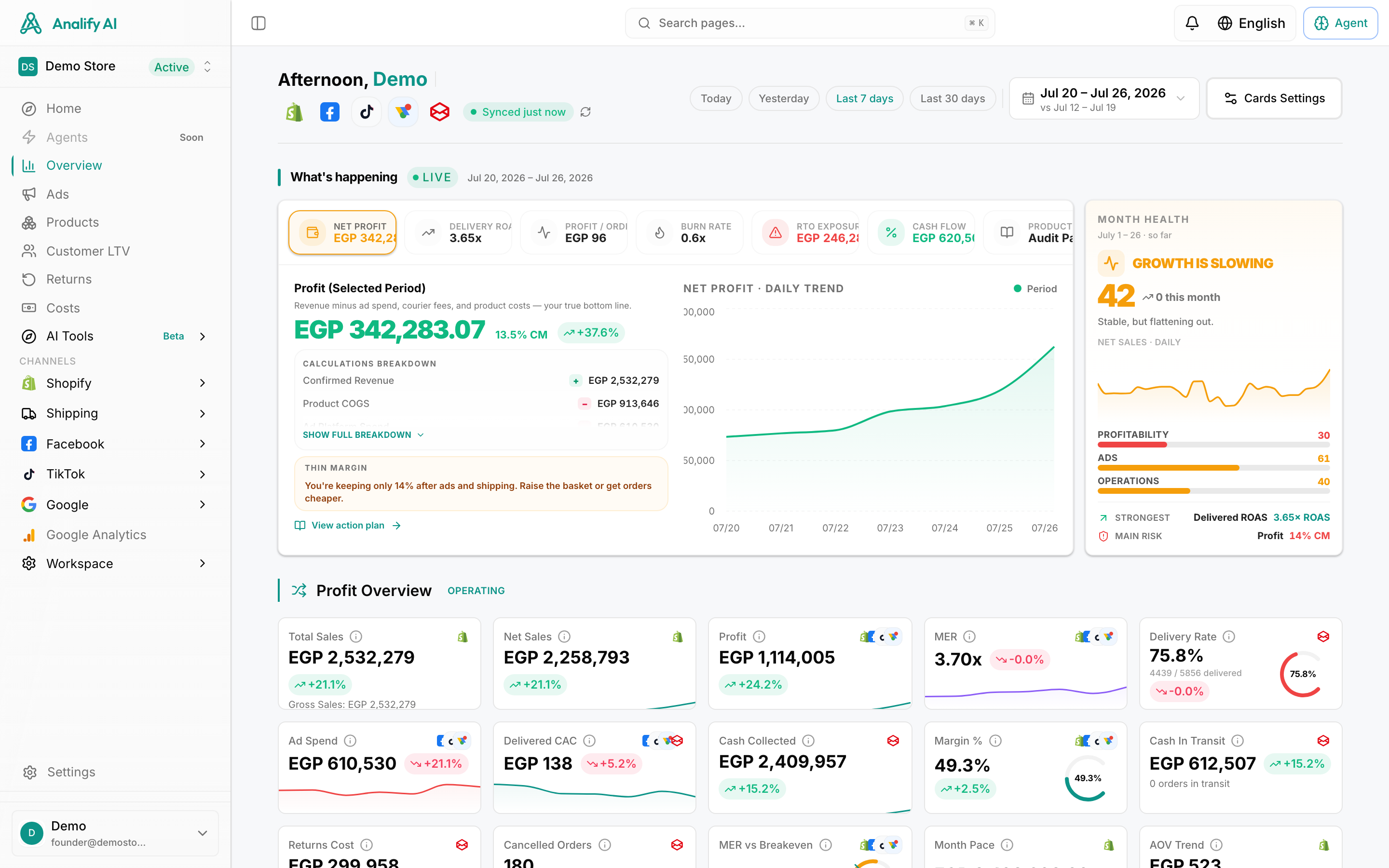
The Scalable Agency Framework: A 7-Step System for Every Client
Alright, let's get to the good stuff. This isn't a random collection of tactics; it's a repeatable framework you can implement across your entire client portfolio. It’s designed for efficiency, scalability, and—most importantly—results.
Step 1: Client Goal Setting & KPI Alignment
Okay, this is the most critical step, and honestly, it's where most agencies trip up. You must move the conversation beyond vanity metrics (likes, followers) and anchor your strategy to real business objectives.
Before you write a single post, sit down with your client and ask the hard questions:
- What is the primary business goal? (e.g., increase online sales by 20%, generate 50 qualified leads per month).
- How does social media fit into that goal?
- What Key Performance Indicators (KPIs) will measure our success? (e.g., ROAS, Cost Per Lead, Conversion Rate ).
Action Item: Standardize this process with a Client Goal-Setting Worksheet. This document becomes the foundation of your strategy and the benchmark against which you’ll report. (Bonus: We're building one for you to download soon!)
Step 2: Audience & Platform Selection
Stop telling every client they "need to be on TikTok." A B2B software company has vastly different needs than a local DTC bakery. A simple way to approach this is with a decision flowchart to guide platform selection based on the client's industry and goals.
- B2C E-commerce: Focus on visually-driven platforms like Instagram, Facebook, and Pinterest. TikTok is a must for reaching younger demographics. The data doesn't lie: a recent analysis shows that Facebook and Instagram lead the pack in ROI for many marketers.
- B2B/Service-Based: LinkedIn is your powerhouse for thought leadership and professional networking. Facebook is still excellent for targeted lead generation ads .
- Local Services (e.g., Plumbers, Salons): Hyper-focus on Facebook and Instagram for local targeting and community engagement. Google Business Profile integration is key.
Don't spread a client's budget and your team's time too thin. It's better to dominate one or two relevant platforms than to have a mediocre presence on five.
Step 3: The "Power Hour" Content Engine
Managing content for 15+ clients is a recipe for burnout unless you have a system. We get it. Enter the "Power Hour" content engine—a framework for batching content creation to maximize efficiency.
- Ideation (15 mins): Brainstorm a month's worth of content pillars (e.g., Educational, Behind-the-Scenes, User-Generated Content, Promotional).
- Creation (30 mins): Batch-create the assets. Write all the captions at once. Design all the graphics at once. Edit all the short-form videos at once. Speaking of which, with 71% of marketers reporting that short-form video offers the highest ROI , this should be a priority.
- Scheduling (15 mins): Use a scheduling tool to load up the entire month's content.
This system turns a chaotic daily task into a focused, monthly process, freeing up your team for more strategic work.
Step 4: Organic Distribution & Community Management
Posting content is only half the battle. The other half is engaging with the community you're trying to build.
- Responding to every comment and DM.
- Engaging with other accounts in your client's niche.
- Monitoring brand mentions and relevant hashtags. Pro Tip:Go where the real conversations are happening. Spend 20 minutes a day on Reddit and Quora searching for keywords related to your client's industry. Answering questions and providing genuine value there canestablish authority and drive highly qualified traffic*.*
Step 5: Paid Amplification & AI Optimization
Organic reach is unpredictable. Paid amplification is how you help ensure your best content gets seen by the right people. The strategy is simple: identify your top-performing organic posts and put an advertising budget behind them.
While 73% of marketers use organic distribution, the most successful ones pair it with paid ads. This is where you can gain a massive competitive edge for your clients. Instead of manually guessing which audiences to target or how to allocate budgets, you can leverage AI.
Pro Tip: Use a tool like Analify AI Marketer . Think of it as a smart assistant for your Meta campaigns. It analyzes performance 24/7, spots winning ad sets, and gives you one-click recommendations to shift budget from underperformers to top performers. It helps your client's budget work smarter, reducing the need for you to babysit campaigns.
Step 6: Performance Tracking & ROI Attribution
This is where you prove your value. You need to connect your social media activities directly to the goals you set in Step 1. This means tracking metrics that actually matter:
- For E-commerce: ROAS (Return on Ad Spend), CPA (Cost Per Acquisition), and AOV (Average Order Value).
- For Lead Gen: CPL (Cost Per Lead), Lead-to-Close Rate, and Form Submissions.
Don't just look at platform-reported metrics. Use a blended ROAS calculation to get a true picture of your marketing effectiveness. It's also important to set realistic expectations. Organic social can have a lower direct conversion rate—around 2.4% for B2C and 1.7% for B2B —but it plays a crucial role in the top and middle of the funnel.
Step 7: Client Reporting That Builds Trust
Stop sending your clients ugly, confusing spreadsheets. Seriously. Your reports should tell a story of progress and prove your agency's value.
A great client report should be:
- Visual: Use graphs and charts to make data digestible.
- Comprehensive: Show performance across all channels in one place.
- Insight-Driven: Don't just show the "what" (CTR went up); explain the "why" (because our new creative resonated with Audience X) and the "what's next" (we're doubling down on this creative style). Quick Tip: This is another area where you can save dozens of hours per month. A dashboarding tool like the reporting tool can be a lifesaver. It integrates with Meta, Google, TikTok, Shopify, Klaviyo, and more to create a live, shareable dashboard. Your clients get a real-time, easy-to-understand view of performance, and your team gets their weekends back. ✨
Your Agency's Tech Stack for Scalable Growth
Having the right framework is essential, but the right tools are what make it fly. A well-curated tech stack can automate tedious tasks, provide deeper insights, and ultimately make your agency more profitable.
Category 1: AI-Powered Advertising & Reporting (Your Competitive Edge)
This is the secret weapon. While the tools above manage your organic presence, this category is all about maximizing the ROI of your paid advertising and proving your worth through crystal-clear reporting.
Analify is built for agencies that take paid advertising seriously. Yes, it uses AI to support Meta ad optimization and campaign management—but its strength is also how it turns performance data into client-ready reporting and business-level visibility.